
|
Parade of the Tall Ships (1976)
Jay A. Chattaway (b. 1946)
Variations on a Korean Folk Song (1967)
John Barnes Chance (1932-1972)
Havana Nights (2018)
Randall D. Standridge (b. 1948)
The Mandalorian (2019/2020)
Ludwig Göransson (b. 1984)
arr. Paul Murtha Arabian Dances (2009)
Brian Balmages (b. 1975)
§====== Intermission ======§ Kirkpatrick Fanfare (1991/2001)
Andrew Boysen, Jr. (b. 1968)
Symphony No. 4: Bookmarks from Japan (2013)
Julie Giroux (b. 1961)
I. Fuji-san – “Mt. Fuji”
II. Nihonbashi – “Bridge Market”
III. The Great Wave off Kanagawa – “The Life of One Wave”
IV. Kinryu-zan Sensoji – “Thunder Gate”
V. Evening Snow at Kambara – “Light is the Touch”
VI. Hakone – “Drifting”
|
Dr. Matthew Morse, conductor
Jay Chattaway is an American composer, primarily of film and television scores. Mr. Chattaway began the study of piano at age seven and trumpet at 11. In junior high school, he began writing music and completed his first extended work while in high school. He received a scholarship to West Virginia University, studying composition there with Thomas Canning and Bud Udell. While working toward a master’s degree there, he was assistant director of the band. Later, he studied arranging and composition at the Eastman School of Music. He was conscripted into the military while working on his graduate degree and joined the Navy Band, serving as the unit’s chief arranger and composer. After his discharge from the Navy, Chattaway moved to New York City to write music. He later moved to Los Angeles to compose for film.
He is mainly known for his work as composer for several Star Trek television series: Star Trek: The Next Generation, Star Trek: Deep Space Nine, Star Trek: Voyager, and Star Trek: Enterprise. The simple flute melody he composed for the TNG episode “The Inner Light” has been re-arranged for full orchestra and remains his best-known and most popular singular work.
Chattaway is also well known as an arranger of big band charts for the Maynard Ferguson Orchestra during the 1970s, and he also composed or co-composed some of Maynard’s hits, including Conquistador, Superbone Meets The Bad Man, and Primal Scream.
Like his counterparts Brian May and Robert O. Ragland, Chattaway’s film scores include music for films such as Maniac, Vigilante, The Last Fight, The Big Score, Walking the Edge, The Rosebud Beach Hotel, Missing in Action, Home Free All, Invasion U.S.A., Silver Bullet, Braddock: Missing in Action III, Maniac Cop, Jakarta, Red Scorpion, Relentless, Maniac Cop 2, The Ambulance, and Rich Girl.
Chattaway has also written many works for high school and college marching, concert, and jazz bands. He appears frequently as a clinician, adjudicator, and guest conductor.
Parade of the Tall Ships was written in 1976 for and dedicated to the United States Navy Band, Commander Ned Muffley, leader, to commemorate Operation Sail 1976, a massive international maritime parade held on July 4, 1976, in New York Harbor to celebrate the United States Bicentennial. It featured 16 major tall ships from 14 nations and over 200 total vessels, it served as a major Cold War-era display of unity, led by the US Coast Guard Cutter Eagle.
John Barnes Chance was an American composer who is well known for his works for concert band. Chance began taking private piano lessons at age 9 and had his first symphony premiered at his high school graduation. Chance earned the degrees of Bachelor of Music and Master of Music from the University of Texas. He studied composition with James Clifton Williams, Kent Kennan, and Paul Pick. After college, he played timpani for the Austin Symphony Orchestra, became an arranger for United States Army Bands and served in Seoul, South Korea. After leaving the army Chance was the composer-in-residence at the Ford Foundation Young Composers Project in Greensboro, North Carolina, from 1960 to 1962. Chance taught at the University of Kentucky from 1966 until his death in 1972.
Variations on a Korean Folk Song is based upon a folk tune that the composer learned while serving the U.S. Army in Seoul, South Korea. The tune is known as Arrirang, a song of love and heartbreak that can be found in many variations, with an origin that may date back 1000 years. The tune is also the basis for the South Korean national anthem. In autumn 1966, for the Journal of Band Research, Chance said:
I became acquainted with the folk song while serving in Seoul, Korea, as a member of the Eighth U.S. Army Band in 1958-59. The tune is not as simple as it sounds, and my fascination with it during the intervening years led to its eventual use as the theme for this set of variations.
Randall D. Standridge is an American composer and arranger who received his Bachelor of Music Education degree from Arkansas State University. During this time, he studied composition with Tom O’Connor, before returning to Arkansas State University to earn his master’s in music composition, studying with Tom O’Connor and Tim Crist. In 2001, he began his tenure as director of bands at Harrisburg High School in Harrisburg, Arkansas. He left this post in 2013 to pursue a career as a full-time composer and marching arts designer.
Mr. Standridge’s music is performed internationally. He has had numerous works selected to the J.W. Pepper’s editor’s choice. His compositions Snake Charmer, Gently Blows the Summer Wind, and Angelic Celebrations have been included in the Teaching Music Through Performance in Band series. He has had numerous works performed at the prestigious Midwest Clinic in Chicago, Illinois. His work Art(isms) was premiered by the Arkansas State University Wind Ensemble at the 2010 CBDNA conference in Las Cruces, New Mexico, and his work Stonewall: 1969 was premiered at the National LGBA conference in 2019. Mr. Standridge is also a contributing composer for Alfred Music’s Sound Innovations: Ensemble Development series.
On Havana Nights, Randall D. Standridge writes:
My musical tastes are wildly eclectic. One moment, you might find me enjoying Beethoven’s symphonies and the other you might find me head-banging to Iron Maiden. I have never been a musical snob, and I value and love the entire array of sounds, rhythms, and textures that the world of music, in all its forms, has to offer.
One genre I have a particular affection for is mambo. Being introduced to the style when I was in high school, I was enchanted with the melodies, rhythms, and excitement that it generates. As I dug more deeply into the style, I was introduced to the work of Yma Sumac, Tito Puente, Pérez Prado, and others. I was absolutely enchanted.
Havana Nights is a concert work for wind ensemble, but it was also conceived as a short ballet. The action takes place in the mambo clubs of Havana as our heroine (Havanna) dances her way through the night life. She encounters another young dancer and the two begin a flirtatious, seductive conversation through the art of movement. As the ballet comes to a close, Havanna casts one final, gleeful look at her would-be suitor before escaping into the night.
This work was commissioned by District 10 of the Ohio Music Educators Association for their 2018 District 10 OMEA Honor Band. I would like to thank them for trusting my creativity and allowing me to create something “entirely else” for wind ensemble. Thank you for letting me use my musical voice.
Also, this work is dedicated to one of my composition professors, Dr. Tom O’Connor. I absolutely could not have done any of this without your guidance, advice, and encouragement. I am forever in your debt.
Peace, Love, and Music.
Ludwig Emil Tomas Göransson is a Swedish composer, conductor, and record producer. Named after Ludwig van Beethoven, he began music lessons at a young age and went on to graduate from the Stockholm Royal College of Music. In 2007, he moved to Los Angeles to study at the University of Southern California Scoring for Motion Picture and Television program. It was at USC that Ludwig met Ryan Coogler.
Göransson composed music for the award-winning short film “Fig” in 2011 (written by Alex George Pickering), which Ryan directed while at USC. The pair would eventually go on to work together on “Fruitvale Station,” “Creed,” and “Black Panther.” Soon after graduating USC he began work assisting Theodore Shapiro. Göransson’s first break came in 2009 as the composer for the comedy “Community.”
For his work on the 2018 superhero film “Black Panther,” he won the Grammy Award for Best Score Soundtrack for Visual Media and the Academy Award for Best Original Score, as well as a nomination for the Golden Globe Award for Best Original Score. Göransson is also known for his work on U.S. TV series “Community”, “Happy Endings,” “New Girl,” and “The Mandalorian.”
Beginning five years after the events of “Return of the Jedi” (1983) and the fall of the Galactic Empire, The Mandalorian follows Din Djarin, a lone Mandalorian bounty hunter in the outer reaches of the galaxy. He is hired by remnant Imperial forces to retrieve the child Grogu, but instead goes on the run to protect the infant. While looking to reunite Grogu with his kind, they are pursued by Moff Gideon, who wants to use Grogu’s connection to the Force.
The Mandalorian music won the 2020 Primetime Emmy for Outstanding Music Composition for a Series.
Brian Balmages is a wind, brass and orchestral composer as well as an active conductor, producer, and performer. He received his bachelor’s degree in music from James Madison University and his master’s degree from the University of Miami in Florida. Balmages’ compositions have been performed worldwide in conferences such as the College Band Directors National and Regional Conferences, the Midwest Clinic, the International Tuba/Euphonium Conference, among others. He has been commissioned for groups such as the Baltimore Symphony Orchestra, the Miami Symphony Orchestra, the University of Miami Wind Ensemble, James Madison University’s School of Music, Boston Brass, members of the United States Marine Band, and the Dominion Brass Ensemble. Balmages is currently the Director of Instrumental Publications for the FJH Music Company Inc. in Fort Lauderdale, Florida.
Arabian Dances was commissioned by the South Carolina Band Directors Association for the All-State Clinic Band. The program notes in the score describe the features of the piece:
After a haunting opening, authentic Middle Eastern percussion instruments create the groove that accompanies the folk song Ala Dal’ona. As the orchestration builds, original themes are intertwined before the percussion ensemble becomes the focus of the third section. The final melody, Tafta Hindi, develops until it morphs into an ostinato over a magnificent presentation of the original theme that is found throughout the work.
Andrew Boysen, Jr. is currently a full professor at the University of New Hampshire. He is the conductor of the wind symphony and teaches conducting and composition. Boysen received his Master of Music degree in wind conducting from Northwestern University and his Bachelor of Music degree in music education and music composition from the University of Iowa. He attended Eastman School of Music where he earned a Doctor of Musical Arts degree in wind conducting. During his time at the school, he was conductor of the Eastman Wind Orchestra and assistant conductor of the Eastman Wind Ensemble. Boysen was the winner of the International Horn Society Composition Contest in 2000, the University of Iowa Honors Composition Prize in 1991 and has twice won the Claude T. Smith Memorial Band Composition Contest, in 1991 and 1994. He remains active as a guest conductor and clinician, appearing with high school, university and festival ensembles across the United States, Great Britain, and Australia.
On Kirkpatrick Fanfare, Andrew Boysen, Jr. writes:
Kirkpatrick Fanfare was commissioned by Central Missouri State University for the dedication of the James C. Kirkpatrick Library in March 1999. This work has a definite Irish flavor, including a strain of Danny Boy. The “fanfare” features driving rhythms and exciting brass figures, making this dramatic work sure to please both performers and audiences alike.
Julie Giroux (pronounced Ji-ROO, as in “Google,” not Ji-ROW, as in “row your boat”) is a prolific composer of music for both film and concert ensembles. She holds degrees from Louisiana State University and includes John Williams, Bill Conti and Jerry Goldsmith among her teachers. Her film scores number over one hundred and include music for the movies Karate Kid II, White Men Can’t Jump, and the mini-series “North and South” (for which she earned an Emmy nomination). Giroux has written for a variety of wind, string, vocal soloists and ensembles; however, she has been composing primarily for wind groups since 1998. As she proudly displays on her website, “I was a band kid and it made me who I am today. Composing for concert bands is a great joy for me as well as an honor.” In addition to composing, Giroux also tours as a guest speaker, guest conductor, and concert pianist of her works.
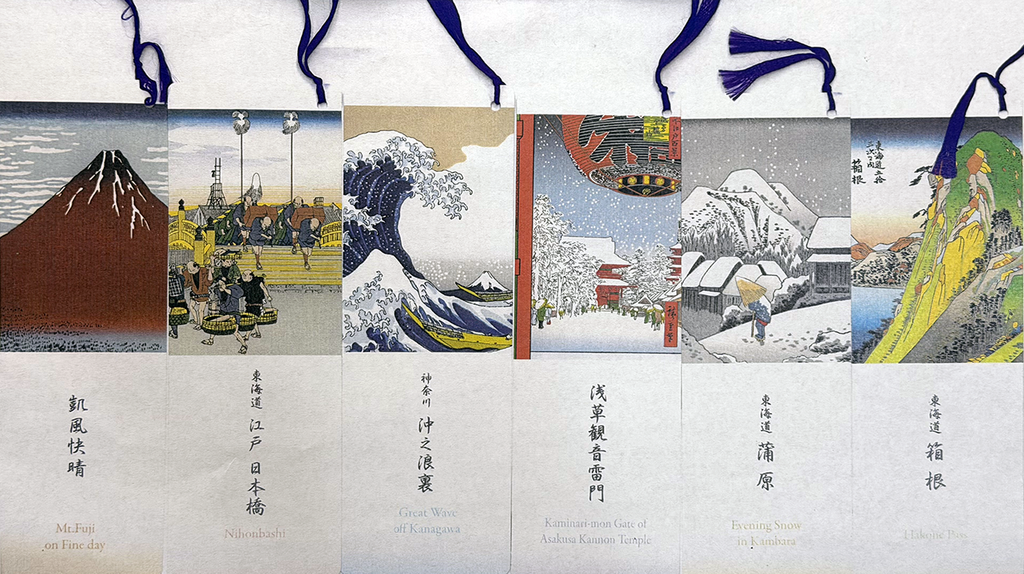
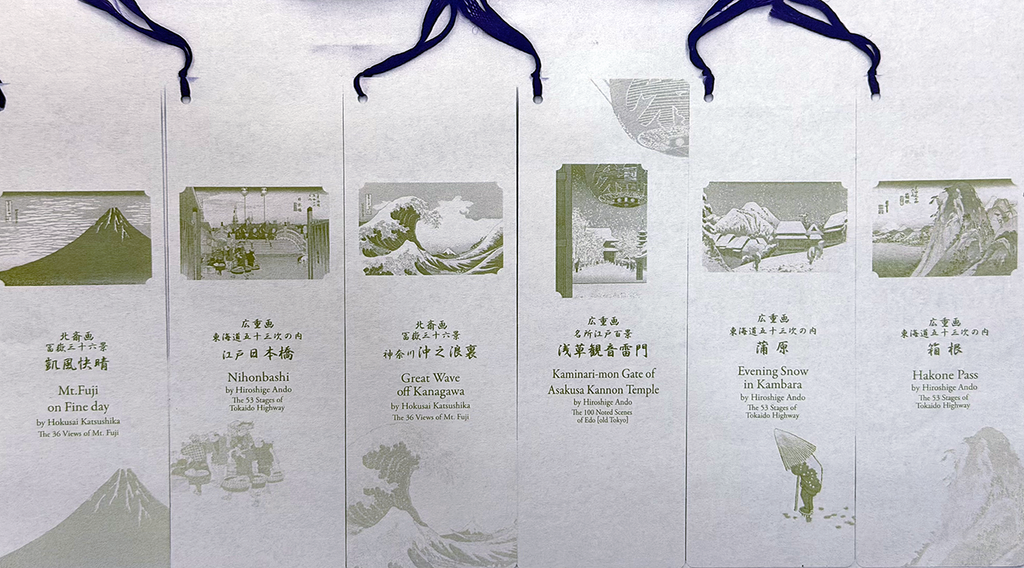
The composer’s inspiration for her Symphony No. 4: Bookmarks from Japan was a gift of six bookmarks featuring famous works by Japanese artists. Ms. Giroux says, “My imagination was whirling with each scene painted on each bookmark. I knew right then and there that those little bookmarks would be the subject of my next symphony.” Two of the six movements are based on selections from Hokusai’s series of woodcut prints, 36 Views of Mt. Fuji. Four movements are based on prints by Hiroshige; three of them are from 53 Stations of the Tokaido Highway which depict the picturesque resting stations along the famous road between Kyoto and Tokyo, and the other is from an additional work.
On each movement of Symphony No. 4: Bookmarks from Japan, Julie Giroux writes:
I. Mount Fuji – “Fuji-san” Based on the bookmark “Fine Wind, Clear Morning” by Hokusai Katsushika which is a woodblock sketch from Hokusai’s collection The 35 Views of Mt. Fuji.
The sketch Fine Wind, Clear Morning (Gaifu kaisei), also known as South Wind, Clear Sky or Red Fuji, by Hokusai Katsushika is the inspiration for this work which is subtitled Fuji-san. In early autumn when, as the original sketch title specifies, the wind is southerly and the sky is clear, the rising sun can turn Mount Fuji red. Fuji-san has many different looks depending on the viewer’s vantage point, time of year, weather and even time of day. Big, bold and easily recognized yet shrouded in mystery and lore, Mount Fuji offers a multitude of inspirational facets.
This piece is based on one view of Mt. Fuji covered in mist and low clouds which slowly burn off as the day progresses. Orchestration and composition techniques follow this scenario, starting off with mysterious, unfocused scoring. As the piece progresses, the scoring gets more focused and bold with the final statement representing Fuji-san in a totally clear view.
II. Nihonbashi – “Market Bridge” Based on the bookmark Nihonbashi by Hiroshige Ando, which is from the print series The 53 Stations of the Tokaido Highway.
Hiroshige Ando (1797-1858) traveled the Tokaido from Edo to Kyoto in 1832. The official party he was traveling with were transporting horses which were gifts to be offered to the imperial court. The journey greatly inspired Hiroshige, for he sketched many of its scenes during his round-trip travels. In all, Hiroshige produced 55 prints for the series The Fifty-Three Stations of the Tokaido. Fifty three of the prints represent each of the 53 post stations along the way. The two additional prints are of the starting and ending points. The post stations offered food, lodging and stables for travelers of the Tokaido Highway.
The Nihonbashi bridge was the central point of development, which is now a business district of Chuo, Tokyo, Japan, aptly named the Nihonbashi District. For centuries it thrived as a mercantile district. The first department store ever developed in Japan was by the Mitsui family named Mitsukoshi. From its early days as a fish market to the current financial district of Tokyo (and Japan), this bridge spanning the Nihonbashi River is a true landmark in Tokyo. In fact, highway signs that state the distance to Tokyo actually state the distance to the Nihonbashi bridge. Up until shortly before 1964, you could see Mount Fuji from the bridge; however, the 1964 Summer Olympics put in a raised expressway over the Nihonbashi bridge, obscuring its view entirely. Petitions to relocate the expressway underground in order to regain view of Mount Fuji are continuous but so far have been futile due to the costs for such a project.
This movement is a melody of my own crafting. It is folk sounding in nature as I was trying to capture the spirit of the bridge going all the way back to 1603 when the first wooden bridge was built over Nihonbashi River. It started out as a fish market but quickly became a place for other merchants to gather. In this piece, the melody gets tossed from instrument to instrument representing the continuous street hawking and haggling.
III. “The Great Wave Off Kanagawa” (Kanagawa-oki nami-ura, lit. “Under a Wave Off Kanagawa”).
The artwork of Hokusai is well known, and this particular woodblock print which was published between 1830 and 1833 is well known throughout the world. His series Thirty-six Views of Mount Fuji is Hokusai’s most famous work. Looking at this stunning print, you can see Mount Fuji in the background, but the central focus is an enormous wave called an okinami (wave of the open sea) peaked and curling with several Japanese boats in different stages entering the perilous wave.
In this work, a single wave is depicted from its beginnings far out in the sparkling sun-drenched seas all the way through its final throes onto a rocky beach. The piece starts in the open sea, fairly calm with sunlight refracting into thousands of tiny points of light. Depicting this are the woodwinds rippling up and down with sixteenth triplet variations. The trombones and french horns enter the mix with a solid melodic statement. The trumpets add in near the end of the phrase all of which depicts the first shaping of the great wave.
IV. Kinryuzan Temple in Asakusa: “Thunder Gate” The name of the print on the bookmark says Kaminari-mon Gate of Asakusa Kannon Temple, but the true name of the print is Kinryuzan Temple in Asakusa by the artist Hiroshige Ando. Hiroshige died before the entire collection was completed. Hiroshige II finished it. The first prints were published in order between 1856 and 1859.
Originally built in 941 A.D., Kaminarimon is the outer gate leading to the Senso-ji Temple which was constructed around 628 A.D. near Kamagata and later relocated to its present location in Asakusa, Tokyo, Japan, in 1635. This large gate features four statues. The Shinto gods Fujin and Raijin are located on the front of the gate, and the Buddhist god Tenryu and goddess Kinryu stand on the reverse side. Fujin displayed on the front east side of the gate is the god of wind and Raijin on the west side is the god of thunder, giving the gate its nickname of “Thunder Gate.”
Displayed in the middle of the gate is a giant red chochin (lantern) which weighs approximately 1,500 pounds. Despite its huge size, it is very fragile. The front of the lantern bears the painting of the gate’s name, Kaminarimon, and the painting on the back reads Furaijinmon, the official name of the gate. The bottom or base of the chochin displays a beautiful wooden carving of a dragon. Over the centuries the gate has been destroyed and rebuilt many times. The current gate dates to 1960 and the new lantern was donated in 2003. As a tourist, you cannot get close to the statues as they are protected by fences and wire and you certainly cannot touch them. Despite all of that, the magnificence of the gate still shines through, bearing testament to centuries of humans that have passed through its structure and the centuries yet to come.
V. “Evening Snow at Kambara”: “Light is the Touch” Based on the bookmark “Evening Snow at Kambara” by Hiroshige Ando which is from the series The 53 Stations of the Tokaido Highway.
Hiroshige Ando (1797-1858) traveled the Tokaido from Edo to Kyoto in 1832. The official party he was traveling with were transporting horses which were gifts to be offered to the imperial court. The journey greatly inspired Hiroshige, for he sketched many of its scenes during his journey’s round trip. In all, Hiroshige produced 55 prints for the series The Fifty-Three Stations of the Tokaido. Fifty three of the prints represent the 53 post stations along the way. The additional two prints are of the starting and ending points. The post stations offered food, lodging and stables for travelers of the Tokaido Highway. “Evening Snow at Kambara” was the 15th station Hiroshige visited.
The subtitle Light is the Touch refers to snow softly falling on the skin. In this piece, the falling snow symbolizes spiritual healing. The piece starts with solo piano, harp and alto flute. The melody is simple yet haunting and grows with the slow addition of players. The piece ends with the same three soloists it began with. It is a song in structure, a song representing the soft touch of healing.
VI. Hakone: “Drifting” Based on the bookmark entitled “Hakone Pass” which is based on the actual print by Hiroshige Ando called “Hakone” which is from the print series The 53 Stations of the Tokaido Highway.
Hiroshige Ando (1797-1858) traveled the Tokaido from Edo to Kyoto in 1832. The official party he was traveling with were transporting horses which were gifts to be offered to the Imperial court. The journey greatly inspired Hiroshige for he sketched many of its scenes during his journey’s round trip. In all, Hiroshige produced 55 prints for the series The Fifty-Three Stations of the Tokaido. Fifty three of the prints represent the 53 post stations along the way. The additional 2 prints are of the starting and ending points. The post stations offered food, lodging and stables for travelers of the Tokaido Highway. Hakone-juku was the tenth of the fifty-three stations of the Tokaido. At an elevation of 725 meters, it is the highest post station on the entire Tokaido Highway, offering spectacular views. Hakone-juku was established in 1618 and over the years has proven to be a hard road to maintain due to its elevation.
When I started researching Hakone there wasn’t much of anything striking a chord within my creative self, just a city that had a long road with lots of curves, switchbacks and other hazards passing through it. It wasn’t until I looked at the actual highway on a map that it rang a bell. I had seen this road before. I truly recognized the shape of the entire highway. Having never been on that actual highway in real life, I knew I had to unravel the mystery. A few more searches on the Internet and there it was. I am an avid “gamer,” and though I tend to play all types of games both on the computer and on consoles, I have always played racing games, and that is where I had “driven” it before, in a video game. The drifting I did on that highway in the game mostly sent me sailing off the road, flying through air and ultimately landing in a fiery, end-over-end wipeout. And as with any search on the Internet, YouTube offered up a seemingly endless supply of videos featuring not one but long parades of cars in single file drifting on the Tokaido Highway as it runs through Hakone.
Subtitled Drifting, this piece reflects my love of fast cars doing crazy fun things. In this instance that would be drifting. Drifting is the art of manipulating the brakes, the gas and precise steering wheel positioning to keep the car in a controlled skid/slide while traveling around curves. The music depicts the adrenaline-racing, heart-pumping action of drifting cars on the Tokaido Highway through Hakone and beyond. It is fast, furious, full of odd meters and features nearly every instrument in the band at least once: my version of musical drifting. Let’s just hope there are no wipeouts or fiery crashes.
Now in his sixth season with the Sacramento Symphonic Winds, Music and Artistic Director Dr. Matthew Morse is currently Director of Bands and Associate Professor of Conducting in the School of Music at California State University, Sacramento, where he conducts the Symphonic Wind Ensemble and the Concert Band, and teaches courses in undergraduate and graduate conducting. He is in demand as a clinician, adjudicator, and guest conductor throughout California and nationwide. Under his direction, the Sacramento State Symphonic Wind Ensemble was selected to perform at the California All-State Music Education Conference in Fresno in February 2019.
Prior to his appointment at Sacramento State, Dr. Morse graduated in May 2017 with a Doctor of Musical Arts degree in Wind Conducting from the University of North Texas, where he was a conducting student of Eugene Migliaro Corporon. He also earned a Master of Arts degree in Instrumental Conducting in 2013 from Indiana University of Pennsylvania, where he was a student of Dr. Jack Stamp, and completed a Bachelor of Arts degree in Music from Thomas Edison State University in Trenton, New Jersey, in 2011.
Concurrent with finishing his undergraduate degree in 2011, Dr. Morse retired as a chief warrant officer four following a 25-year military music career with the United States Army. Early in his career, Dr. Morse served for nearly 12 years as a multi-instrumentalist performing primarily on euphonium and trombone and serving two alternating tours each with the 4th Infantry Division Band at Fort Carson, Colorado, and the United States Army Japan Band, Camp Zama, Japan. In 1997, Dr. Morse was selected to become a warrant officer bandmaster and served as the commander and conductor of the 3rd Infantry Division Band at Fort Stewart, Georgia, the 1st Armored Division Band, then stationed Wiesbaden, Germany, and the 282nd Army Band at Fort Jackson, South Carolina. He deployed as a band commander to combat zones in Bosnia-Herzegovina in 2000 and twice to Iraq during a 15-month period in 2003-04. In 2007, Dr. Morse was selected by competitive audition for his capstone assignment as the associate bandmaster and director of the Jazz Knights of the United States Military Academy Band at West Point, New York, where he shared the stage with numerous name artists and soloists.
Dr. Morse has appeared as a guest conductor with many groups, including the United States Army Field Band, the United States Army Europe Band and Chorus, the West Point Band, and the Air Force Band of the Golden West. He has conducted the California Music Educators Association Capitol Section High School Honor Band as well as the Northern California Band Association All Northern Honor Band and the Northern California Band and Choral Directors Association NorCal High School Honor Band. As an instrumentalist, he has performed on bass trombone in recent years with the North Texas Wind Symphony, the Keystone Wind Ensemble (most recently at the 2025 Texas Bandmasters Association convention in San Antonio, Texas in July 2025), various ensembles at Indiana University of Pennsylvania, and the Pueblo Symphony Orchestra in Pueblo, Colorado, along with various freelance settings, including an orchestra backing Bernadette Peters in 2012 and a big band backing Doc Severinsen in 2014.
Dr. Morse’s military decorations include the Legion of Merit, the Bronze Star Medal, and the Meritorious Service Medal with four oak leaf clusters. Other awards and recognitions include being a finalist for The American Prize in the university conductor category, the John Philip Sousa Foundation’s Colonel George S. Howard Citation of Musical Excellence for Military Concert Bands for his work with the 282nd Army Band in 2007, and the South Suburban Conference (Minneapolis/St. Paul, Minnesota area) Achievement Award in Fine Arts in 2013. Additionally, Dr. Morse received the Thomas Jefferson High School (Bloomington, Minnesota) Fine Arts Hall of Fame award in 2009. Morse also holds a second-degree black belt in Tae Kwon Do through Young Brothers Tae Kwon Do Associates in Pittsburgh, Pennsylvania.
Dr. Morse’s professional affiliations include the College Band Directors’ National Association, National Band Association, National Association for Music Education and the California Music Educators Association, California Band Director’s Association, Northern California Band Association, Phi Mu Alpha Sinfonia Fraternity, and Phi Kappa Phi Honor Society.
 SSW is an all volunteer adult community concert band / wind ensemble based in the greater Sacramento area.