|
Ukrainian Bell Carol
arr. Richard L. Saucedo
Three Ayres from Gloucester
Hugh M. Stuart
1. The Jolly Earl of Cholmondeley
2. Ayre for Eventide
3. The Fiefs of Wembley
You Better Sleigh!
JaRod Hall
The Free Lance March
John Philip Sousa
Edited and Interpreted by William D. Revelli Russian Christmas Music
Alfred Reed
§====== Intermission ======§ Persistence
Richard L. Saucedo
Fum, Fum, Fum
arr. Chip Davis
Band Arrangement by Robert Longfield Salvation is Created
Pavel Tschesnokoff
arr. Bruce H. Houseknecht Ride
Samuel R. Hazo
A Christmas Festival
Leroy Anderson
|
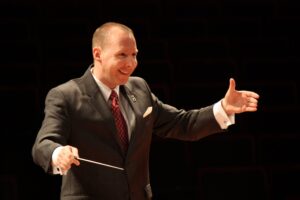
Dr. Matthew Morse, conductor
Mykola Dmytrovych Leontovych was a Ukrainian composer, choral conductor, and teacher of international renown.
His music was inspired by Mykola Lysenko and the Ukrainian national music school. Leontovych specialized in a cappella choral music, ranging from original compositions, to church music, to elaborate arrangements of folk music.
Leontovych was born and raised in the Podolia Governorate of the Russian Empire (present-day Ukraine). He was educated as a priest in the Kamianets-Podilskyi Theological Seminary and later furthered his musical education at the Saint Petersburg Court Capella and private lessons with Boleslav Yavorsky. With the independence of the Ukrainian state in the 1917 revolution, Leontovych moved to Kiev where he worked at the Kiev Conservatory and the Mykola Lysenko Institute of Music and Drama.
His music was inspired by Mykola Lysenko and the Ukrainian national music school. Leontovych specialized in a cappella choral music, ranging from original compositions, to church music, to elaborate arrangements of folk music. He is recognized for composing Shchedryk in 1904 (which premiered in 1916), known to the English-speaking world as Carol of the Bells or as Ring Christmas Bells. He is known as a martyr in the Eastern Orthodox Ukrainian Church, where he is also remembered for his liturgy, the first liturgy composed in the vernacular, specifically in the modern Ukrainian language. He was assassinated by a Soviet agent in 1921.
During his lifetime Leontovych’s compositions and arrangements became popular with professional and amateur groups alike across Ukraine. Performances of his works in western Europe and North America earned him the nickname “the Ukrainian Bach” in France. Apart from his very popular Shchedryk, Leontovych’s music is performed primarily in Ukraine and the Ukrainian diaspora.
Ukrainian Bell Carol is Richard Saucedo’s arrangement of Leontovych’s Carol of the Bells and combines the traditional tune with some more modern and recognizable music for a fun and appropriate opener to our concert.
Hugh M. Stuart received his music training from Oberlin Conservatory of Music, Columbia Teachers College, Rutgers University, Newark State College, and the University of Michigan. He taught instrumental music in the schools of Maryland and New Jersey for 33 years. During this time, he conducted several brass bands and ensembles. He also taught at various clinics and workshops for winds. Stuart wrote more than 100 published compositions, arrangements, method books, band and orchestral collections, solos, and ensembles in the educational field. He appeared as a clinician in forty-five states. He lived in Albuquerque, N.M. until his death on Jan. 31, 2006 at the age of 89.
Three Ayres from Gloucester is a three-movement suite written in the early English folksong style, this piece came into being as a result of the composer’s fascination with an old 10th century couplet: “There’s no one quite so comely As the Jolly Earl of Cholmondeley.” The resulting three compositions, The Jolly Earl of Cholmondeley, Ayre for Eventide, and The Fiefs of Wembley, are in early English folk song style and are designed to capture the mood of the peasants and their life on the fiefs of Wembley castle.
JaRod Hall is a Texas-native educator, performer, and composer. He holds a bachelor’s degree in music education from the University of North Texas where he studied conducting with Nicholas Williams and Dennis Fisher. He is currently the director of bands at Hobby Middle School in San Antonio, Texas. JaRod’s bands have received consistent sweepstakes awards at the Texas University Interscholastic League Concert and Sightreading Evaluations, as well as being recognized at the state level. In 2018 and 2019, JaRod’s bands at Griffin Middle School earned the Citation of Excellence award, honoring the top two non-varsity bands in the state of Texas.
A passionate performer, JaRod has been a part of many ensembles such as the North Texas Wind Symphony and Symphonic Band, 3 O’ Clock Lab Band, Carrollton Wind Symphony, Metropolitan Winds, and during his time in high school the Texas All-State Symphonic Band (2007-09) and Jazz Band (2010). He served as drum major for the 2013 Crossmen Drum and Bugle Corps and was a member of the 2014 Disneyland All-American College Band. He is currently a freelance tubist and trombonist in the San Antonio area.
As a composer, JaRod’s compositions appear on the Texas Prescribed Music List, The J.W. Pepper “Editor’s Choice” list, and the Bandworld Top 100 list. His composition Lost Woods Fantasy was showcased at the 73rd annual Midwest Clinic in Chicago by the Berkner High School Band, which was composed of the first students JaRod taught as a band director in Richardson ISD. His composition Silver Fanfare was selected as a winner of the Dallas Winds Call for Fanfares, and Through the Storm was selected as the 2021 Barbara Buehlman Prize winner for high school band, featured at the 76th annual Midwest clinic in Chicago.
On You Better Sleigh!, JaRod Hall writes:
This work was inspired by Stetson Begin and the Krimmel Intermediate Band. Stetson called me up one day and said, “JaRod! I just had this vision of a sassy, jazzy, holiday piece. Can you write something like that for us?” I couldn’t possibly have said “yes” any faster.
You Better Sleigh! plays on two terms: a “sleigh” – which is inarguably very winter-themed here in the States-and “slay”-which has evolved to encompass many definitions, mostly centered on the theme of doing something extremely well. The latter definition pays homage to both the LGBTQIA+ and Black communities-popularized by drag culture.
The style of the piece is funk, an entire genre of music pioneered and popularized in 1960s America by Black musicians, most notably James Brown. Funk evolved from jazz and is heavily influenced by R&B, soul, and dance music. What makes funk really dance is the bass line and percussion grooves, typically complex in nature. This genre gave rise to timeless groups such as Earth, Wind & Fire, Kool & The Gang. Sly and the Family Stone, and Jimi Hendrix-eventually shaping the course of pop and dance music across the world.
You will hear snippets of various holiday tunes hidden throughout the piece. Try to find them all!
John Philip Sousa was probably America’s best-known composer and conductor during his lifetime.
Sousa was born the third of 10 children of John Antonio Sousa (born in Spain of Portuguese parents) and Maria Elisabeth Trinkhaus (born in Bavaria). John Philip’s father, Antonio, played trombone in the U.S. Marine band, so young John grew up around military band music. Sousa started his music education, playing the violin, as a pupil of John Esputa and G. F. Benkert for harmony and musical composition at the age of six, and was found to have absolute pitch. When Sousa reached the age of 13, his father enlisted his son in the United States Marine Corps as an apprentice. Sousa served his apprenticeship for seven years, until 1875, and apparently learned to play all the wind instruments while also continuing with the violin.
Several years later, Sousa left his apprenticeship to join a theatrical (pit) orchestra where he learned to conduct. He returned to the U.S. Marine Band as its head in 1880 and remained as its conductor until 1892. He organized his own band the year he left the Marine Band. The Sousa Band toured 1892-1931, performing 15,623 concerts. In 1900, his band represented the United States at the Paris Exposition before touring Europe. In Paris, the Sousa Band marched through the streets including the Champs-Élysées to the Arc de Triomphe – one of only eight parades the band marched in over its forty years.
Sousa wrote 136 marches. He also wrote school songs for several American Universities, including Kansas State University, Marquette University, the University of Michigan, and the University of Minnesota. Sousa died at the age of 77 on March 6th, 1932, after conducting a rehearsal of the Ringgold Band in Reading, Pennsylvania. The last piece he conducted was The Stars and Stripes Forever.
The Free Lance March, taken from Sousa’s 1906 operetta of the same name, has a lengthy and unorthodox construction when compared with most other Sousa marches. There are so many spirited march tunes in the operetta that perhaps Sousa felt obligated to include most of them when piecing together the march. Actually, there were enough for two separate marches.
The trio of the march corresponds to the song On to Victory in the operetta, and some editions of the march were published under that title.
This version of the tune was edited by William Revelli, longtime director of bands at Michigan University in the middle of the twentieth century.
Alfred Reed began studying music at the age of ten. After serving in the 529th Air Force Army Band during World War II, Reed studied at the Julliard School of Music under Vittorio Gianni. After working as staff composer and arranger for the NBC and ABC television networks, Reed received his bachelor’s degree in music in 1955 and his master’s degree in 1956 from Baylor University, where he became the conductor of the Baylor Symphony Orchestra. He was a professor of music at the University of Miami, where he established the first university music business program. He was also chairman of the department of Music Media and Industry and director of the Music Industry Program at the time of his retirement. Reed composed over two hundred works for concert band, chorus, orchestra, and chamber ensembles and traveled often as a guest conductor of his works in North America, Latin America, Europe, and Asia.
Russian Christmas Music is based on a Russian Christmas carol and combines original material and some themes from liturgical music of the Eastern Orthodox Church. The piece was written in November 1944 and performed for the first time in December of that year before being revised. The first performances of the second version of the piece occurred in 1948 by the Juilliard Band under Donald I. Moore, and the second by the Syracuse University Symphonic Band under Harwood Simmons, to whom the work was dedicated. Although Russian Christmas Music was written in the form of a single, continuous piece, four distinct sections are recognized, which Reed had originally subtitled “Children’s Carol”, “Antiphonal Chant”, “Village Song” and “Cathedral Chorus”.
Richard Saucedo is an American composer known for his works for marching band, concert band and orchestra. Saucedo completed his undergraduate degree at Indiana University in Bloomington and received his master’s degree at Butler University in Indianapolis. He is on the composing staff for Hal Leonard Publications and his original compositions have been performed by middle school, high school and university groups all over the world. In 2013, he retired as Director of Bands and Performing Arts Department Chairman at Carmel High School in Carmel, Indiana. He has been a guest clinician and conductor in multiple international festivals including the Singapore International Band Festival, the Japan Band, the Australian Band and Orchestra Clinic in Sydney, the 2017 Midwest Clinic and the 2018 Texas Music Educators Association convention.
Richard Saucedo marked the opening of Persistence with the term “with unrelenting energy!” with good reason. The percussion section along with inventive hemiola rhythmic patterns in the winds propels this intense segment. The mood shifts completely for the slow Misterioso section which is characterized by layers of instrumental colors and rich brass statements. Rhythmic patterns and interplay between all sections of the band help to energize the final segment, leading to an exciting and powerful finish.
Louis F. “Chip” Davis, Jr. is an American composer, arranger and performer, and the founder and leader of the music group Mannheim Steamroller. His family then moved to Portland, Ohio, and, when Davis was 11, to Sylvania, Ohio. He began piano lessons at age 4 and had composed his first piece of music at age 6. He graduated from Sylvania High School and went on to graduate from the University of Michigan music school, specializing in bassoon and percussion.
After touring with the Norman Luboff Choir, he took a job with an Omaha, Nebraska, advertising agency writing jingles. These included spots for a local bakery featuring the fictional trucker C. W. McCall. The spots were co-written with advertising writer William Fries, who became the voice of McCall. The spots were so popular, they were persuaded to begin writing non-advertising songs featuring McCall. The most famous of these is the 1975 Convoy. The duo released a total of five albums between 1974 and 1979. Davis was named SESAC Country Music Writer of the Year in 1976.
Davis founded Mannheim Steamroller in 1974 to showcase his interest in fusing modern popular and classical techniques. The first Fresh Aire album was completed shortly after. It was turned down by major record labels, so Davis founded American Gramaphone to release the album. American Gramaphone has been the label for all subsequent Mannheim Steamroller releases. A total of eight Fresh Aire albums were released, concluding with Fresh Aire 8 in 2000.
Mannheim Steamroller released Mannheim Steamroller Christmas in 1984; it is credited with revolutionizing the “traditional” sounds of Christmas. The group’s subsequent Christmas music albums have sold tens of millions of copies and become among the most popular recordings in that genre. His annual Mannheim Steamroller Christmas concert tour has continued for over 25 years across the country.
Davis was awarded his 19th Gold Record in 2010. The Recording Industry Association of America (RIAA) has also awarded Davis four Multi-Platinum and eight Platinum records.
Fum, Fum, Fum is a traditional Catalan Christmas carol, thought to have originated in the 16th or 17th century. The word “fum” means smoke in Catalan, and it may simply refer to the smoke rising from a chimney as seen from afar, or, as indicated in the New Oxford Book of Carols, “may imitate the sound of a drum (or perhaps the strumming of a guitar)”. It is not typical of Spanish tradition but rather of Catalan tradition.
One source, the Musical Heritage Society insert 3428 (Christmas Songs From Around the World), indicates that “fum, fum, fum” is an onomatopoeia imitating the noise of a rocking cradle, and that the rhythms come from the Sardana, a courtly dance which originated in Catalonia and the Provence.
Chip Davis has given us an appealing treatment of the holiday classic. The woodwinds and percussion receive the spotlight throughout this effectively orchestrated arrangement. A terrific holiday change of pace.
Pavel Grigorievich Tchesnokov was a Russian Empire and Soviet composer, choral conductor and teacher.
Tchesnokov (the name is also transliterated Tschesnokoff, Chesnokov, Tchesnokoff, and Chesnokoff) was born near Moscow. While attending the Moscow Conservatory, he received extensive training in both instrumental and vocal music including nine years of solfege, and seven years training for both the piano and violin. His studies in composition included four years of harmony, counterpoint, and form. During his years at the school, he had the opportunity to study with prominent Russian composers like Sergei Taneyev and Mikhail Ippolitov-Ivanov, who greatly influence his style of liturgy-driven, choral composition.
At an early age, Tchesnokov gained recognition as a great conductor and choirmaster while leading many groups including the Russian Choral Society Choir. This reputation earned him a position on staff at the Moscow Conservatory where great composers and music scholars like Tchaikovsky shared their skills and musical insight. There he founded a choral conducting program, which he taught from 1920 until his death.
By the age of 30, Tchesnokov had completed nearly four hundred sacred choral works, but his proliferation of church music came to a standstill at the time of the Russian revolution. Under communist rule, no one was permitted to produce any form of sacred art. So in response, he composed an additional hundred secular works and conducted secular choirs like the Moscow Academy Choir and the Bolshoi Theatre Choir. In the Soviet era religion was often under oppression, and the Cathedral of Christ the Saviour, whose last choirmaster had been Chesnokov, was destroyed. This disturbed him so deeply that he stopped writing music altogether.
Today, Tchesnokov is most known for his piece Salvation is Created as well as works such as Do Not Reject Me in Old Age (solo for basso profondo). His anthem O Lord God has served as the signature benedictory of Luther College’s Nordic Choir (Decorah, Iowa, USA) since 1948.
This arrangement is almost an exact transcription of the original choral work composed in 1912, before Tchesnokov was forced to turn to secular compositions by the Soviet government. It is a communion hymn based on a chant from Kiev and Psalm 74 (73 in the Greek version): “Salvation is made in the midst of the earth, O God. Alleluia.” It is transposed up 1/2 step from the original to accommodate the wind ensemble. There are other minor rhythmic changes; otherwise, there is no deviation from the original. The work is in two sections, each in “A-B-Coda” form.
Arranger Bruce Houseknecht was director of bands at Joliet Township High School from 1945 to 1969, and head of the Department of Fine Arts at Joliet Junior College.
Samuel R. Hazo is an American composer who received his bachelor’s and master’s degrees from Duquesne University where he served on the Board of Governors and was awarded as Duquesne’s Outstanding Graduate in Music Education. He resides in Pittsburgh, Pennsylvania, with his wife and children.
In 2003, Mr. Hazo became the first composer in history to be named the winner of both composition contests sponsored by the National Band Association. He has composed for the professional, university and public school levels in addition to writing original scores for television, radio and the stage.
Mr. Hazo has been a music teacher at every educational grade level from kindergarten through college, including tenure as a high school and university director. He was twice named “Teacher of Distinction” by the Southwestern Pennsylvania Teachers’ Excellence Foundation. Mr. Hazo serves as a guest conductor and is a clinician for Hal Leonard Corporation. He is also sponsored by Sibelius Music Software. Recordings of his compositions appear on Klavier Records and Mark Records.
On Ride, Samuel R. Hazo writes:
Ride was written as a gesture of appreciation for all of the kind things Jack Stamp has done for me, ranging from his unwavering friendship to his heartfelt advice on composition and subjects beyond. During the years 2001 and 2002, some wonderful things began to happen with my compositions that were unparalleled to any professional good fortune I had previously experienced. The common thread in all of these things was Jack Stamp. I began to receive calls from all over the country, inquiring about my music, and when I traced back the steps of how someone so far away could know of my (then) unpublished works, all paths led to either reading sessions Jack had conducted, or recommendations he had made to band directors about new pieces for wind band. The noblest thing about him was that he never let me reciprocate in any way, not even allowing me to buy him dessert after a concert. All he would ever say is, “Just keep sending us the music,” which I could only take as the privilege it was, as well as an opportunity to give something back that was truly unique.
In late April of 2002, Jack had invited me to take part in a composer’s forum he had organized for his students at Indiana University of Pennsylvania. I was to present alongside Joseph Wilcox Jenkins, Mark Camphouse, Bruce Yurko and Aldo Forte. This forum was affectionately referred to in my house as “four famous guys and you.” It was such a creatively charged event, that everyone who took part was still talking about it months after it happened. Following the first day of the forum, Jack invited all of the composers to his house, where his wife Lori had prepared an incredible gourmet dinner. Since I didn’t know how to get to Jack’s house (a/d/a Gavorkna House) from the university, he told me to follow him. So he and his passenger, Mark Camphouse, began the fifteen-minute drive with me behind them. The combination of such an invigorating day as well as my trying to follow Jack at the top speed a country road can be driven, is what wrote this piece in my head in the time it took to get from the IUP campus to the Stamp residence. Ride was written and titled for that exact moment in my life when Jack Stamp’s generosity and lead foot were equal in their inspiration as the beautiful Indiana, Pennsylvania, countryside blurring past my car window.
Leroy Anderson was an American composer, born to Swedish immigrants. He attended Harvard University where he received Bachelor and Master of Arts degrees in music and eventually attained a Ph.D. in German and Scandinavian languages. His composition teachers included George Enescu and Walter Piston. While in school he tutored music at Ratcliffe College and was director of the Harvard University Band.
After hearing Anderson’s arrangements for band, Arthur Fiedler asked him to do an arrangement of Harvard songs for the Boston Pops Orchestra. This eventually led to the orchestra performing original works by Anderson. He served in the United States Army during World War II as an interpreter for the Counterintelligence Corps and rose to the positions of chief of the Scandinavian Department of Military Intelligence.
After the war, Anderson moved to Connecticut and composed some of his most successful works, including Sleigh Ride (1948). His The Syncopated Clock (1945) was used as the theme show for The Late Show for 25 years and his album “Blue Tango” sold over a million copies in 1952. As his compositions grew in popularity, Anderson conducted more with orchestras across the United States.
He was awarded a star on the Hollywood Walk of Fame the year after his death in 1975.
A Christmas Festival is a concert overture built upon traditional Christmas songs. Originally recorded by the Boston Pops, it is the Christmas medley that sets the standard for all others. Anderson has encompassed the joy, celebration, and solemnity of Christmas in his arrangements of Joy to the World, Deck the Halls, God Rest Ye Merry Gentlemen, Good King Wenceslas, Hark the Herald Angels Sing, Silent Night, Jingle Bells, O Little Town of Bethlehem, and Adeste Fidelis.
Now in his fifth season with the Sacramento Symphonic Winds, Music and Artistic Director Dr. Matthew Morse is currently Director of Bands and Associate Professor of Conducting in the School of Music at California State University, Sacramento, where he conducts the Symphonic Wind Ensemble and the Concert Band, oversees the Marching Band, and teaches courses in undergraduate and graduate conducting. He is in demand as a clinician, adjudicator, and guest conductor throughout California and nationwide. Under his direction, the Sacramento State Symphonic Wind Ensemble was selected to perform at the California All-State Music Education Conference in Fresno in February 2019.
Prior to his appointment at Sacramento State, Dr. Morse graduated in May 2017 with a Doctor of Musical Arts degree in Wind Conducting from the University of North Texas, where he was a conducting student of Eugene Migliaro Corporon. He also earned a Master of Arts degree in Instrumental Conducting in 2013 from Indiana University of Pennsylvania, where he was a student of Dr. Jack Stamp, and completed a Bachelor of Arts degree in Music from Thomas Edison State University in Trenton, New Jersey, in 2011.
Concurrent with finishing his undergraduate degree in 2011, Dr. Morse retired as a chief warrant officer four following a 25-year military music career with the United States Army. Early in his career, Dr. Morse served for nearly 12 years as a multi-instrumentalist performing primarily on euphonium and trombone and serving two alternating tours each with the 4th Infantry Division Band at Fort Carson, Colorado, and the United States Army Japan Band, Camp Zama, Japan. In 1997, Dr. Morse was selected to become a warrant officer bandmaster and served as the commander and conductor of the 3rd Infantry Division Band at Fort Stewart, Georgia, the 1st Armored Division Band, then stationed Wiesbaden, Germany, and the 282nd Army Band at Fort Jackson, South Carolina. He deployed as a band commander to combat zones in Bosnia-Herzegovina in 2000 and twice to Iraq during a 15-month period in 2003-04. In 2007, Dr. Morse was selected by competitive audition for his capstone assignment as the associate bandmaster and director of the Jazz Knights of the United States Military Academy Band at West Point, New York, where he shared the stage with numerous name artists and soloists.
Dr. Morse has appeared as a guest conductor with many groups, including the United States Army Field Band, the United States Army Europe Band and Chorus, the West Point Band, and the Air Force Band of the Golden West. He has conducted the California Music Educators Association Capitol Section High School Honor Band as well as the Northern California Band Association All Northern Honor Band and the Northern California Band and Choral Directors Association NorCal High School Honor Band. As an instrumentalist, he has performed on bass trombone in recent years with the North Texas Wind Symphony, the Keystone Wind Ensemble (most recently at the 2025 Texas Bandmasters Association convention in San Antonio, Texas in July 2025), various ensembles at Indiana University of Pennsylvania, and the Pueblo Symphony Orchestra in Pueblo, Colorado, along with various freelance settings, including an orchestra backing Bernadette Peters in 2012 and a big band backing Doc Severinsen in 2014.
Dr. Morse’s military decorations include the Legion of Merit, the Bronze Star Medal, and the Meritorious Service Medal with four oak leaf clusters. Other awards and recognitions include being a finalist for The American Prize in the university conductor category, the John Philip Sousa Foundation’s Colonel George S. Howard Citation of Musical Excellence for Military Concert Bands for his work with the 282nd Army Band in 2007, and the South Suburban Conference (Minneapolis/St. Paul, Minnesota area) Achievement Award in Fine Arts in 2013. Additionally, Dr. Morse received the Thomas Jefferson High School (Bloomington, Minnesota) Fine Arts Hall of Fame award in 2009. Morse also holds a second-degree black belt in Tae Kwon Do through Young Brothers Tae Kwon Do Associates in Pittsburgh, Pennsylvania.
Dr. Morse’s professional affiliations include the College Band Directors’ National Association, National Band Association, National Association for Music Education and the California Music Educators Association, California Band Director’s Association, Northern California Band Association, Phi Mu Alpha Sinfonia Fraternity, and Phi Kappa Phi Honor Society.
 SSW is an all volunteer adult community concert band / wind ensemble based in the greater Sacramento area.