|
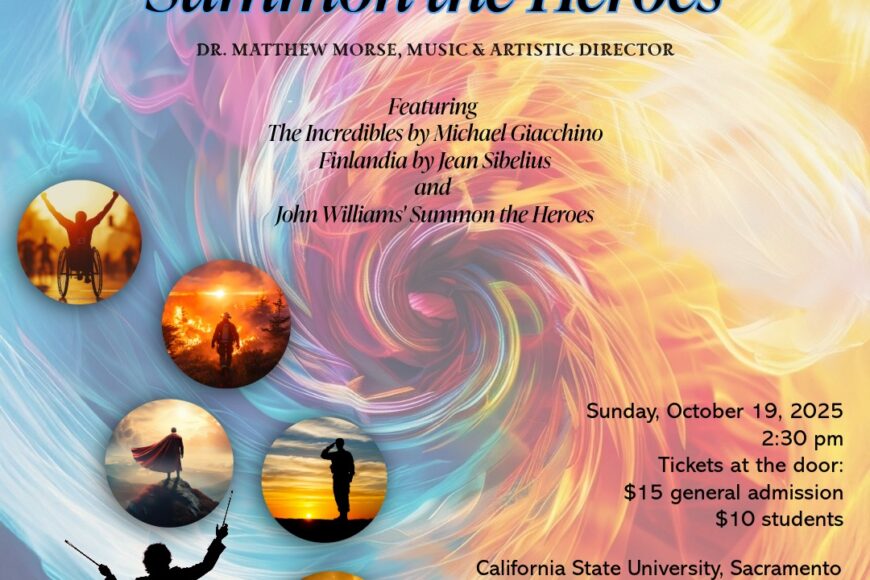
Summon the Heroes
John Williams
arr. Paul Lavender My Hero from “The Chocolate Soldier”
Oscar Straus
Paraphrased and scored by Harry L. Alford Finlandia. Tone Poem.
Jean Sibelius
arr. Frank Winterbottom Themes from 007
arr. Robert W. Lowden
Fanfare HAYABUSA
Satoshi Yagisawa
§====== Intermission ======§ Symphony Nr.1 “The Lord of the Rings” I. Gandalf
Johan de Meij
October
Eric Whitacre
Red Tails
Ayatey Shabazz
Music from The Incredibles
Michael Giacchino
arr. Jay Bocook The Twelve Gallon Hat
Julie Giroux
|
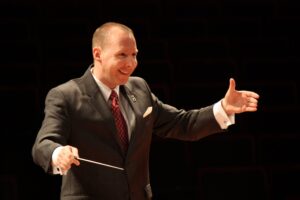
Dr. Matthew Morse, conductor
Program Notes
There are very few composers in the world whose work is more recognizable than John Towner Williams. Born in New York, he learned piano at the age of eight. After moving with his family to Los Angeles in 1948 the young pianist and now leader of his own jazz band started experimenting with arranging. Having determined as a teen that he would become a concert pianist, he premiered his first composition, a piano sonata, at age 19.
After serving in the U. S. Air Force in the early 1950s, where he orchestrated for and conducted service bands, Williams moved back to New York where he began studies with Rosina Lhévinne at the Juilliard School and played in jazz clubs and studio sessions to support himself. Following this, he returned to California, where he attended both Los Angeles City College and UCLA, studying orchestration with Robert Van Epps, and composition with Mario Castelnuovo-Tedesco and Arthur Olaf Andersen, among others.
From 1956, Williams served as a studio pianist in Hollywood and shortly after began arranging and composing music for television, and becoming pianist, composer, and staff arranger for Columbia Records, where he made a number of albums with André Previn. Later, he went on to steady work as staff arranger at 20th Century Fox, orchestrating for notable film composers of the day, including Alfred Newman, Dmitri Tiomkin, and Franz Waxman.
Recognition of his television work in the 1950s and 60s, which won him four Emmy awards, led to work in major films. Probably his most famous collaborations have been with Steven Spielberg on a number of films including the “Indiana Jones” series and with George Lucas on the “Star Wars” series. In 1980, Williams was named the nineteenth conductor of the Boston Pops Orchestra, a position he held until 1993, when he became Conductor Laureate. Williams continues to be active in scoring movies into the 21st century with over 110 films to his credit.
His film recognitions include five Academy Awards (with 51 nominations), four Golden Globes (with 22 nominations), seven British Academy Film Awards, and twenty Grammy awards (with 64 nominations), and the American Film Institute’s Lifetime Achievement Award.
When the American Film Institute released their listing of the top twenty-five film scores of all time in 2005, it included the titles Out of Africa, Sunset Boulevard, Ben-Hur, Psycho, The Godfather, and Gone with the Wind. John Williams was responsible for three of those twenty-five selections, and at the very top was his unforgettable score to the original Star Wars movie.
John Williams was asked a second time to compose a work for the Olympic Games, and this thrilling composition is the result. Summon the Heroes was selected as the official theme of the 100th Anniversary of the Olympics, and literally millions of people all over the world heard the theme throughout the 1996 Summer Games, and during broadcasts of many subsequent games. This powerful arrangement includes the five major sections of the work: Fanfare; Prologue; Flags; Contest, and Parade.
Regarding his inspiration, John Williams wrote, “There is unquestionably a spiritual, non-corporeal aspect to an athletic quest such as this that brings us close to what art is all about.”
Oscar Nathan Straus was a Viennese composer of operettas and film scores and songs.
His original name was actually Strauss, but for professional purposes he deliberately omitted the final ‘s’, since he wished not to be associated with the musical Strauss family of Vienna. However, he did follow the advice of Johann Strauss II in 1898 about abandoning the prospective lure of writing waltzes for the more lucrative business of writing for the theatre. He also wrote about 500 cabaret songs, chamber music, and orchestral and choral works.
The son of a Jewish family studied music in Berlin under Max Bruch, and became an orchestral conductor, working at the Überbrettl cabaret. He went back to Vienna and began writing operettas, becoming a serious rival to Franz Lehár. When Lehár’s popular The Merry Widow premiered in 1905, Straus was said to have remarked “Das kann ich auch!” (I can also do that!). In 1939, following the Nazi Anschluss, he fled to Paris, where he received the honor of a Chevalier of the Légion d’honneur, and then to Hollywood. After the war, he returned to Europe, and settled at Bad Ischl, where he died.
Straus’ best-known works are Ein Walzertraum (A Waltz Dream), and The Chocolate Soldier (Der tapfere Soldat). The waltz arrangement from the former is probably his most enduring orchestral work. Among his most famous songs is the theme song from the 1950 film La Ronde.
The Chocolate Soldier (German title: Der tapfere Soldat or Der Praliné-Soldat) is an operetta composed in 1908 by Oscar Straus based on George Bernard Shaw’s 1894 play, Arms and the Man.
In an aria titled My Hero from Act I, Nadina idolizes the heroism of her fiancé, the self-opinionated Major Alexis Spiridoff. However, her illusions are later shattered upon learning from Lieutenant Bumerli – the “chocolate solder” of the title, so-called because of his passion for chocolate drops – that Alexis had never intended to lead the brilliant cavalry charge for which he is famed: his horse actually bolted with him, and his troops dutifully followed!
Harry Alford is reported to have arranged this work for the pioneering University of Illinois band director Albert Austin Harding.
Johan Julius Christian Sibelius was a Finnish composer of the late Romantic period. His music played an important role in the formation of the Finnish national identity. Although Finnish by birth, his first language remained Swedish all his life. Romantic Nationalism was to become a crucial element in Sibelius’ artistic output and his political leanings.
From around the age of 15, he set his heart on becoming a great violin virtuoso, and he did become quite an accomplished player of the instrument, even publicly performing the last two movements of the Mendelssohn Violin Concerto in Helsinki.
After Sibelius graduated from high school in 1885, he began to study law at the Imperial Alexander University of Finland (now the University of Helsinki). However, he was more interested in music than in law, and he soon quit his studies. From 1885 to 1889 Sibelius studied music in the Helsinki music school (now the Sibelius Academy). Sibelius continued studying in Berlin (from 1889 to 1890 with Albert Becker) and in Vienna (from 1890 to 1891). It was around this time that he finally abandoned his cherished violin playing aspirations: “It was a very painful awakening when I had to admit that I had begun my training for the exacting career of a virtuoso too late”.
The core of Sibelius’ oeuvre is his set of seven symphonies. Like Beethoven, Sibelius used each successive work to further develop his own personal compositional style. His works continue to be performed frequently in the concert hall and are often recorded.
In addition to the symphonies, Sibelius’s best-known compositions include Finlandia, the Karelia Suite, Valse triste, the Violin Concerto in D minor and The Swan of Tuonela (one of the four movements of the Lemminkäinen Suite). Other works include pieces inspired by the Finnish national epic, the Kalevala; over 100 songs for voice and piano; incidental music for 13 plays; the opera Jungfrun i tornet (The Maiden in the Tower); chamber music; piano music; Masonic ritual music; and 21 separate publications of choral music.
Sibelius composed prolifically until the mid-1920s. However, after completing his Seventh Symphony (1924), the incidental music to The Tempest (1926), and the tone poem Tapiola (1926), he produced no large-scale works for the remaining thirty years of his life.
The Finnish 100-mark bill featured his image until it was taken out of circulation in 2002. Since 2011, Finland celebrates a Flag Day on 8 December, the composer’s birthday, also known as the ‘Day of Finnish Music.’
While Sibelius was a young man, his native Finland struggled for independence from Russia. In 1899, with press censorship at its peak, a group of Helsinki artists organized a series of celebrations in support of those journalists who wrote about the oppressiveness of Russian rule. There was to be a stage pageant presenting scenes from Finnish history. As the country’s foremost composer, Sibelius was the obvious choice to compose the incidental music. He wrote a prelude and six pieces, one for each scene in the pageant. The final scene was a short segment titled Finlandia.
Probably Sibelius’ most widely known work, Finlandia gives the impression that it is constructed from folk songs taken from the rich folk music culture of Finland. This belief became so widespread that Sibelius was forced to make a public declaration to dispel the erroneous conclusion, “There is a general impression abroad that my themes are often folk melodies. So far, I have never used a theme that was not my own creation. Thus, the thematic material of Finlandia is entirely my own.”
Robert William Lowden was an American composer and arranger, who attended Temple University as a music education student and later became a trombonist and arranger with the U.S. Army Band. He also did arranging for Claude Thornhill and Oscar Dumont. He taught instrumental music in the public schools of Camden, New Jersey (1958-1968). He left this position to devote full time to composing and arranging music for school bands, stage bands, orchestras, and small ensembles. He is best known for his band arrangements of current popular and show music.
Themes from 007 brings us back to the James Bond films of the late 70s and early 80s starring Sean Connery and Roger Moore with themes like Goldfinger, From Russia with Love, Diamonds are Forever, Nobody Does It Better from “The Spy Who Loved Me,” For Your Eyes Only, Live and Let Die, and the James Bond Theme.
Satoshi Yagisawa is a Japanese composer, who graduated from the Department of Composition and later completed the master’s coursework at the graduate school of at Musashino Academia Musicae. He studied composition under Kenjiro Urata, Hitoshi Tanaka, and Hidehiko Hagiwaya, in addition to studying trumpet under Takeji Sekine and band instruction under Masato Sato.
His compositions for wind orchestra are popular in Japan and many other countries. They were introduced in Teaching Music Through Performance in Band, published by GIA Publications in the United States, published by De Haske Publications in Holland and Bravo Music in America, selected as a compulsory piece for the University of North Texas Conductors’ Collegium, and performed at the 12th World Association for Symphonic Bands and Ensembles (WASBE) in Singapore and the Midwest Clinic (2008) in Chicago. In Japan, he has composed music for National Arbor Day, National Sports Festival, Japan Intra-High School Athletic Meets as well as numerous leading ensembles in Japan. Yagisawa was appointed Ceremonial Music Director for the National Sports Festival 2010 in the State of Chiba, Japan.
Other professional activities include festival adjudication, guest conducting, teaching, lecturing, writing columns for music magazines and advisory work for a music publisher. He is one of the most energetic young composers in Japan today. Currently he teaches wind, string, and percussion instruments at Tokyo Music & Media Arts, Shobi. He is also a member of “Kyo-En”, an organization that premieres outstanding original works by Japanese composers.
Amongst Yagisawa’s major works for winds are A Poem for Wind Orchestra – Hymn to the Infinite Sky; Machu Picchu: City in the Sky – The mystery of the hidden Sun Temple; and Perseus – A Hero’s Quest in the Heavens. In addition to his band compositions, he has composed for several other genres, including orchestral, chamber, and choral works.
Hayabusa (Japanese for “Peregrine falcon”) was a robotic spacecraft developed by the Japan Aerospace Exploration Agency (JAXA) to return a sample of material from a small near-Earth asteroid named 25143 Itokawa to Earth for further analysis. Hayabusa, formerly known as MUSES-C for Mu Space Engineering Spacecraft C, was launched on 9 May 2003 and rendezvoused with Itokawa in mid-September 2005. After arriving at Itokawa, Hayabusa studied the asteroid’s shape, spin, topography, color, composition, density, and history. In November 2005, it landed on the asteroid and collected samples in the form of tiny grains of asteroidal material, which were returned to Earth aboard the spacecraft on 13 June 2010.
Fanfare – HAYABUSA was commissioned by the band of NEC Tamagawa, conducted by Ikuo Inagaki, to commemorate the success of the Hayabusa mission. At the premiere performance in Minato Ward, Tokyo, the piece was so successful the audience demanded it be performed again as an encore.
Dutch composer Johan de Meij studied at the Royal Conservatory of Music in The Hague. He began his studies in trombone and euphonium performance and played with various orchestras and groups in the Netherlands before focusing exclusively on composition. He is a regular guest conductor of the Simón Bolívar Youth Wind Orchestra in Caracas, Venezuela, a group which is part of the educational program El Sistema. He is the principal guest conductor for the New York Wind Symphony and the Kyushu Wind Orchestra in Fukuoka, Japan. De Meij has also established his own publishing company, Amstel Music.
His Symphony No. 1 The Lord of the Rings was premiered in 1988 by the Groot Harmonieorkest van de Belgische Gidsen conducted by Norbert Nozy. It is based on the Lord of the Rings book series by J.R.R. Tolkien and each of the five movements is based on a character or important event from the books. The symphony was awarded the Sudler Composition Prize and has been recorded by many ensembles including The London Symphony Orchestra, The North Netherlands Orchestra, The Nagoya Philharmonic and The Amsterdam Wind Orchestra. 2018 marks the 30th anniversary of the piece.
Eric Whitacre began playing piano at an early age and played keyboards in high school. He played trumpet in the marching band but was kicked out for being obnoxious. Despite this inauspicious beginning, Whitacre became a music major at the University of Nevada, Las Vegas (Bachelor of Music 1995). His first real exposure to classical music was when he sang Mozart’s Requiem with the school choir. The experience caused him to learn to read music and to think like a classical composer. His first assignment, writing a work for 100 trombones and percussion, was a failure. Shortly afterwards, he overheard the sound of a wind symphony rehearsal and was drawn to it. The director, Tom Leslie, encouraged Whitacre’s ideas for a composition that, in 1995, became Ghost Train. His Godzilla Eats Las Vegas!, written in 1996 struck a whimsical chord with many, including the U.S. Marine Band and international audiences. Whitacre earned a master’s degree in 1997 from the Juilliard School of Music. He currently lives in Los Angeles and composes film scores and works for chorus and band. In 2012, he received a Best Choral Performance Grammy as composer and conductor for the album “Light & Gold.”
On October, Eric Whitacre writes:
October is my favorite month. Something about the crisp autumn air and the subtle change in light always make me a little sentimental, and as I started to sketch I felt that same quiet beauty in the writing. The simple, pastoral melodies and subsequent harmonies are inspired by the great English romantics (Vaughan Williams and Elgar) as I felt that this style was also perfectly suited to capture the natural and pastoral soul of the season. I’m quite happy with the end result, especially because I feel there just isn’t enough lush, beautiful music written for winds.
October was commissioned by the Nebraska Wind Consortium, Brian Anderson, Consortium Chairman. October was premiered on May 14th, 2000, and is dedicated to Brian Anderson, the man who brought it all together.
Ayatey Shabazz is an American composer, arranger, educator, and clinician, who received his formal training from the University of Southern Mississippi. He studied composition and arranging under Dr. Albert Gower, who inspired him to make composing his life work.
Mr. Shabazz is very active as an arranger/composer for many high school and college programs as well as other idioms of music such as drum corps, jazz, film and television projects. He also travels extensively conducting clinics, adjudicating concert festivals and marching band contests, and is a Pro-Mark educator endorser. Shabazz has taught beginning through high school band, and is the founder, president and CEO of The Devmusic Company and Devmusic Educational Systems.
On Red Tails, Ayatey Shabazz writes:
In spite of adversity and limited opportunities, African Americans have played a significant role in U.S. military history over the past 300 years. They were denied military leadership roles and skilled training because many believed they lacked qualifications for combat duty. Before 1940, African Americans were barred from flying for the U.S. military.
Civil rights organizations and the Black press exerted pressure that resulted in the formation of an all-African-American pursuit squadron based in Tuskegee, Alabama, in 1941. They became known as the Tuskegee Airmen and later nicknamed “Red Tails.”
During the 1920s and 30s, the exploits of record-setting pilots like Charles Lindbergh and Amelia Earhart had captivated the nation, and thousands of young men and women clamored to follow in their footsteps. But young African Americans who aspired to become pilots met with significant obstacles, starting with the widespread (racist) belief that Black people could not learn to fly or operate sophisticated aircraft.
For the training site, the War Department chose the Tuskegee Army Airfield in Tuskegee, Alabama, then under construction. Home to the prestigious Tuskegee Institute, founded by Booker T. Washington, it was located in the heart of the Jim Crow South.
A poster entitled Unsung Heroes was on display in the Cinebistro at the premier of the Red Tails film, alongside tables of books filled with articles, photos and information about the Tidewater Chapter of the Tuskegee Airmen Inc. On the poster was a quote: “The ultimate judge of a person’s character is their ability exceed expectations when little recognition or praise is given.”
The Tuskegee Airmen also contributed to the desegregation of base facilities and to the desegregation of the armed forces, which in turn contributed to the end of segregation in the United States.
During the war, the Tuskegee Airmen received over 150 Distinguished Flying Crosses to 95 flyers, including two awarded to Airmen [sic] Captain William A. Campbell, 14 Bronze Stars (4th highest military decoration), and 744 Air Medals. The Congressional Gold Medal was also presented to over 300 Tuskegee Airmen or their spouses. Barack Obama wrote that his “career in public service was made possible by the path heroes like the Tuskegee Airmen trail-blazed.” The Tuskegee Airmen helped to create opportunities for people of color and led to integrated armed forces in 1948.
The Airmen’s record low loss number while escorting bombers in WWII is unmatched by any other fighter group. Their services were in constant demand among the Allied bomber units. Their nearly flawless protection of the bombers, combined with the red-painted tails on their aircraft, earned them the nickname “Red Tail Angels” or “Red Tails.”
Michael Giacchino (pronounced “Juh-KEEN-oh”) started venturing into music at the age of ten, where he spent his time between the cinema and his basement. Creating his own stop motion animation films on his brother’s pool table, he found the most enjoyable part of the process was putting music to the pictures.
He later joined the School of Visual Arts in New York where he received a major in film production and a minor in history. During his time there he took an unpaid internship at Universal Pictures as well as working at a department store to pay the rent.
He graduated in 1990 with a Bachelor of Fine Arts and began studying music at the Juilliard School at the Lincoln Center. He worked day jobs at the publicity offices for Universal and Disney. Two years later he moved to Disney Studios in Burbank, working in their feature film publicity department as well as taking night classes in music at UCLA.
His work at Disney involved interacting with various people from the film industry, including producers who hire composers. When a role became available for a producer at Disney Interactive, Michael took the job, allowing him to hire himself to write music for their games. His first major composition came in 1997 when newly formed DreamWorks Interactive asked him to score their video game adaptation of The Lost World: Jurassic Park. It became the first PlayStation game to have a live orchestral score.
Michael continued writing for video games including Small Soldiers, Warpath: Jurassic Park, and in 1999, the first in the Medal Of Honor franchise, on which he would eventually score four further sequels.
In 2001, rising director J.J. Abrams, a fan of Michael’s Medal Of Honor scores, hired him to write for his new show, Alias. It also led to Michael’s largest project, Lost, on which he scored all 120 episodes of the show from 2004-2010, as well as writing a symphonic concert of the music which debuted in Hawaii in 2007. The final recording session for the show took place on May 7th, 2010, and a farewell concert was held a week later which was attended by many fans, cast and crew.
During his period on Lost, Michael continued writing for video games including Call Of Duty and Secret Weapons Over Normandy and also launched his career into feature films in 2004 when he was asked to score Pixar’s The Incredibles, directed by Brad Bird. In 2006 Michael scored J.J. Abrams’ first feature film, Mission: Impossible III and continued to work with him on Cloverfield, Star Trek, and Super 8, as well as providing music for the pilot episodes of Fringe and Alcatraz.
Michael also continued his work with Pixar, scoring Ratatouille which earned him an Oscar nomination, and Up for which he won two Grammys, a Golden Globe, a Bafta, and an Oscar.
Michael is also an advisory board member of Education Through Music Los Angeles, an organization that promotes the integration of music into the curricula of disadvantaged schools. His recent projects have included John Carter and Star Trek Into Darkness. Michael has also been involved in several concerts of his work performed in the USA and Europe.
The Incredibles is a 2004 American computer-animated superhero film, written and directed by Brad Bird, released by Walt Disney Pictures, and was the sixth film produced by Pixar Animation Studios. The story follows a family of superheroes living a quiet suburban life, forced to hide their powers. When father Bob Parr’s yearning for his glory days and desire to help people drags him into battle with an evil villain and his killer robot, the entire Parr family is forced into action to save the world. Michael Giacchino’s wonderful score harkens back to the spy thriller themes of the 1960s and 70s.
Julie Giroux (pronounced Ji-ROO (as in “Google,” not Ji-ROW, as in “row your boat”) is a prolific composer of music for both film and concert ensembles. She holds degrees from Louisiana State University and includes John Williams, Bill Conti and Jerry Goldsmith among her teachers. Her film scores number over one hundred and include music for the movies Karate Kid II, White Men Can’t Jump,
and the mini-series “North and South” (for which she earned an Emmy nomination). Giroux has written for a variety of wind, string, vocal soloists and ensembles; however, she has been composing primarily for wind groups since 1998. As she proudly displays on her website, “I was a band kid and it made me who I am today. Composing for concert bands is a great joy for me as well as an honor.” In addition to composing, Giroux also tours as a guest speaker, guest conductor, and concert pianist of her works.
On The Twelve Gallon Hat, Julie Giroux writes:
When looking at the lineup for the Klavier/Naxos recording in January 2014, I realized there was a need for music of a lighter nature and composed The Twelve Gallon Hat. The original title was The Nine and a Half Gallon Hat. However, following the first reading session, the musicians who sightread the piece all agreed that it was at least 12 gallons in size, so that is the title.
Fond of Western television and film music like Bonanza, Silverado, City Slickers, The Magnificent Seven and many, many others, I decided to compose a work as a tribute to my favorites. It is a wild ride to be certain, with double tonguing faster than any 6-shooter and woodwind runs flying across the page like tumbleweed. Tie yourself into the saddle and hang on for this fast and furious romp across the wild, wild, wild West!
Now in his fifth season with the Sacramento Symphonic Winds, Music and Artistic Director Dr. Matthew Morse is currently Director of Bands and Associate Professor of Conducting in the School of Music at California State University, Sacramento, where he conducts the Symphonic Wind Ensemble and the Concert Band, oversees the Marching Band, and teaches courses in undergraduate and graduate conducting. He is in demand as a clinician, adjudicator, and guest conductor throughout California and nationwide. Under his direction, the Sacramento State Symphonic Wind Ensemble was selected to perform at the California All-State Music Education Conference in Fresno in February 2019.
Prior to his appointment at Sacramento State, Dr. Morse graduated in May 2017 with a Doctor of Musical Arts degree in Wind Conducting from the University of North Texas, where he was a conducting student of Eugene Migliaro Corporon. He also earned a Master of Arts degree in Instrumental Conducting in 2013 from Indiana University of Pennsylvania, where he was a student of Dr. Jack Stamp, and completed a Bachelor of Arts degree in Music from Thomas Edison State University in Trenton, New Jersey, in 2011.
Concurrent with finishing his undergraduate degree in 2011, Dr. Morse retired as a chief warrant officer four following a 25-year military music career with the United States Army. Early in his career, Dr. Morse served for nearly 12 years as a multi-instrumentalist performing primarily on euphonium and trombone and serving two alternating tours each with the 4th Infantry Division Band at Fort Carson, Colorado, and the United States Army Japan Band, Camp Zama, Japan. In 1997, Dr. Morse was selected to become a warrant officer bandmaster and served as the commander and conductor of the 3rd Infantry Division Band at Fort Stewart, Georgia, the 1st Armored Division Band, then stationed Wiesbaden, Germany, and the 282nd Army Band at Fort Jackson, South Carolina. He deployed as a band commander to combat zones in Bosnia-Herzegovina in 2000 and twice to Iraq during a 15-month period in 2003-04. In 2007, Dr. Morse was selected by competitive audition for his capstone assignment as the associate bandmaster and director of the Jazz Knights of the United States Military Academy Band at West Point, New York, where he shared the stage with numerous name artists and soloists.
Dr. Morse has appeared as a guest conductor with many groups, including the United States Army Field Band, the United States Army Europe Band and Chorus, the West Point Band, and the Air Force Band of the Golden West. He has conducted the California Music Educators Association Capitol Section High School Honor Band as well as the Northern California Band Association All Northern Honor Band and the Northern California Band and Choral Directors Association NorCal High School Honor Band. As an instrumentalist, he has performed on bass trombone in recent years with the North Texas Wind Symphony, the Keystone Wind Ensemble (most recently at the 2025 Texas Bandmasters Association convention in San Antonio, Texas in July 2025), various ensembles at Indiana University of Pennsylvania, and the Pueblo Symphony Orchestra in Pueblo, Colorado, along with various freelance settings, including an orchestra backing Bernadette Peters in 2012 and a big band backing Doc Severinsen in 2014.
Dr. Morse’s military decorations include the Legion of Merit, the Bronze Star Medal, and the Meritorious Service Medal with four oak leaf clusters. Other awards and recognitions include being a finalist for The American Prize in the university conductor category, the John Philip Sousa Foundation’s Colonel George S. Howard Citation of Musical Excellence for Military Concert Bands for his work with the 282nd Army Band in 2007, and the South Suburban Conference (Minneapolis/St. Paul, Minnesota area) Achievement Award in Fine Arts in 2013. Additionally, Dr. Morse received the Thomas Jefferson High School (Bloomington, Minnesota) Fine Arts Hall of Fame award in 2009. Morse also holds a second-degree black belt in Tae Kwon Do through Young Brothers Tae Kwon Do Associates in Pittsburgh, Pennsylvania.
Dr. Morse’s professional affiliations include the College Band Directors’ National Association, National Band Association, National Association for Music Education and the California Music Educators Association, California Band Director’s Association, Northern California Band Association, Phi Mu Alpha Sinfonia Fraternity, and Phi Kappa Phi Honor Society.
 SSW is an all volunteer adult community concert band / wind ensemble based in the greater Sacramento area.