|
Moorside March (1928/1960)
Gustav Holst (1874-1934)
arr. Gordon Jacob First Suite In E flat (1909)
Gustav Holst
1. Chaconne
2. Intermezzo
3. March
Suite Dreams (2007)
Steven Bryant (b. 1972)
Bach’s Fugue á la Gigue (1707/1928)
Johann Sebastian Bach (1685-1750)
trans. Gustav Holst §====== Intermission ======§ Mars from “The Planets” (1916/1924)
Gustov Holst
Jupiter from “The Planets” (1916/1924)
Gustov Holst
The EARTH from “Planets” by Trouvère (2014)
Jun Nagao (b. 1964)
|
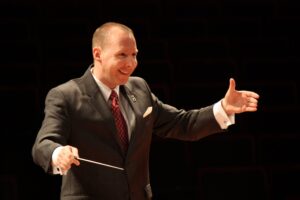
Dr. Matthew Morse, conductor
Gustav Holst began composing while at Cheltenham Grammar School. He spent two months at Oxford learning counterpoint before going to London to study composition at the Royal College of Music. He met Ralph Vaughan Williams in 1895. The two became friends and started the habit of playing their compositions to each other. Holst left college in 1898 to play the trombone in the Carl Rosa Opera Company and later the Scottish Opera, taught at the James Allen’s Girls’ School in Dulwich for two years before being appointed Director of Music at St. Paul’s Girls’ School in Hammersmith in 1905, where he continued to teach until the end of his life. Holst’s heavy and exhausting teaching schedule meant that time left available for composition was often fragmented. In 1929, he accepted the Howland Memorial Prize from Yale University in 1929 for distinction in the arts and the gold medal of the Royal Philharmonic Society in 1930. He was appointed visiting lecturer in composition at Harvard University in January 1932.
Moorside March is taken from Holst’s Moorside Suite for brass band which was commissioned as the test piece for the British National Brass Band Championship at the Crystal Palace, London, in 1928. Gordon Jacob arranged the suite for wind band in 1960. The march begins with a rising, four-note motif which leads into a vigorous theme, noteworthy because of its six-bar phrases. A second theme, employing more normal eight-bar phrases, is introduced by the saxophone. The trio is reminiscent of the ceremonial marches of Edward Elgar and William Walton in its pomp and dignity. After a brief modulatory section based on the opening motif, the first two themes are restated, and the march concludes with a coda containing material from the trio.
Gustav Holst’s work, First Suite in E-flat is considered a model of British composition for wind bands. Composed in 1909, First Suite in E-flat is known to be one of the first compositions for wind band with instrumentation as is common today. Holst pioneered a style based mainly on melody that combined Elizabethan folk music techniques and 20th Century composition to bring a characteristic color to his music. His work for military band is heavy in brass writing which was typical of the music of that time. First Suite in E-flat is comprised of three movements based on traditional forms: Chaconne, Intermezzo, and March. Originally, Holst composed the piece in a flexible fashion, making it playable by a group of only 19 performers but with the ability to accommodate up to 16 more individual parts. What was different about this work for its time was the featuring of prominent soloists within the band and the treatment of certain sections as chamber ensembles. The first movement, Chaconne, is actually mislabeled as it would be more fitting to call it a passacaglia. The movement contains a repeating 8 measure phrase, as opposed to a ground bass line, that is handed around the different sections. With each repetition, Holst creates a variation among the accompaniment each time the theme returns, thus giving each repetition of the theme a different feel. The movement has a mostly legato feel with the prominence of low pitches. The second movement, Intermezzo, has two different styles: a detached, staccato feel in the first section; and a gentle legato near the middle of the movement. The third movement is a March with a contrasting legato section in the trio that alludes to the main theme of the first movement passacaglia.
Steven Bryant studied composition at The Juilliard School, the University of North Texas and Ouachita Baptist University. His teachers and mentors include Cindy McTee, W. Francis McBeth and Frank Ticheli. Bryant has been commissioned to compose for the Amherst Saxophone Quartet, The Indiana University Wind Ensemble, the United States Air Force Band of Mid-America, the Calgary Stampede Band and the University of Nevada, and Las Vegas Wind Symphony. His works have also been commissioned, performed and recorded in England, Japan, Australia and Germany. Along with composers Eric Whitacre, Jonathan Newman, and Jim Bonney, Bryant is a founding member of BCM International, a consortium made up of these composers whose goal is to create high-quality literature for concert and educational needs. The son of a professional trumpet player and music educator, Bryant values education and his compositions include a number of works for young ensembles. Aside from works for wind ensemble and orchestra, his catalog contains electronic and electro-acoustic pieces.
Suite Dreams was commissioned and premiered by the Jasper (IN) High School Wind Ensemble, conducted by James Goodhue. In 2008, it was awarded the William D. Revelli Composition Award by the National Band Association. It is the last of four parody pieces by Bryant. The previous three are: Chester Leaps In, ImPercynations, and MetaMarch. However Bryant states “Unlike the others, it’s not intentionally funny and tongue-in-cheek in character. Rather, it’s a dream-like fantasia based on Holst’s First Suite in E-flat. The motivic material is almost exclusively from the inverted Chaconne melody in Mvt. I and from Mvt. III.”
Johann Sebastian Bach was a German composer and musician of the Baroque period. Bach enriched established German styles through his skill in counterpoint, harmonic and motivic organization, and the adaptation of rhythms, forms, and textures from abroad, particularly from Italy and France. Bach’s compositions include the Brandenburg concerti, the Mass in B minor, The Well-Tempered Clavier, two Passions, keyboard works, and more than 300 cantatas, of which nearly 100 cantatas have been lost to posterity. His music is revered for its intellectual depth, technical command, and artistic beauty.
Bach was born in Eisenach, Saxe-Eisenach, into a great musical family; his father, Johann Ambrosius Bach, was the director of the town musicians, and all of his uncles were professional musicians. His father probably taught him to play violin and harpsichord, and his brother, Johann Christoph Bach, taught him the clavichord and exposed him to much contemporary music. Apparently at his own initiative, Bach attended St Michael’s School in Lüneburg for two years. After graduating, he held several musical posts across Germany: he served as Kapellmeister (director of music) to Leopold, Prince of Anhalt-Köthen, Cantor of the Thomasschule in Leipzig, and Royal Court Composer to August III. Bach’s health and vision declined in 1749, and he died on 28 July 1750. Modern historians believe that his death was caused by a combination of stroke and pneumonia.
Bach’s abilities as an organist were highly respected throughout Europe during his lifetime, although he was not widely recognised as a great composer until a revival of interest and performances of his music in the first half of the nineteenth century. He is now generally regarded as one of the main composers of the Baroque period, and as one of the greatest composers of all time.
When British composer Gustav Holst was commissioned to write his monumental work Hammersmith for the BBC Wireless Military Band in 1928 he felt rather out of practice in orchestrating for the medium. For some years he had had the idea of arranging some Bach fugues for brass and military band, so he set himself the task of scoring the Organ Fugue in G Major BWV 577 (from Preludes, Fugues and Fantasias). He, rather than Bach, called it Fugue à La Gigue.
The piece made an ideal exercise, and Holst’s brilliant dovetailing of the counterpoint between different instruments shows his mastery. The piece is technically demanding and the characteristic unison clarinet writing suggests the orchestral conception of a large wind ensemble rather than a band. It was this conception which the composer carried forward into Hammersmith.
Fugue à La Gigue was published for military band in 1928 by Boosey & Hawkes and shortly afterwards for orchestra, but with only short scores, as was customary at the time.
Mars “the Bringer of War,” the first movement of what was to become Holst’s “The Planets” suite, was complete in the composer’s mind in the summer of 1914, when the First World War was but an emerging threat. The work is dominated by a relentless hammering out of a 5/4 rhythm which suggests the relentless destruction of war. The opposition of harmony and rhythm is skillfully used to produce a startling aural and emotional effect. The movement was transcribed for band by the composer is 1924.
Jupiter, “the Bringer of Jollity,” with its Falstaffian sense of humor, is the most popular of the movements of Holst’s “The Planets” suite, and it conveys the astrological significance of Jupiter as benevolent and generous. Perhaps the cause of its popularity lies in the very English tune which is introduced toward the middle of the movement. Solemn and carol-like, the melody was later arranged as the hymn tune Thaxted, after the village where Holst lived for many years. Adapted to fit a poem by Sir Cecil Spring-Rice, I vow to thee, my country, the music became associated with the strong patriotic feelings resulting from the human cost of World War I. Later, the tune was incorporated in the hymn O God Beyond All Praising. It has even been used as the theme of the Rugby Union World Cup since 1991.
Japanese composer, Jun Nagao is known for his work on film and games. However, he began his career as a composer and arranger for wind bands and orchestras. Nagao holds a master’s degree in composition from the Tokyo National University of Fine Arts and Music where he studied with Masayuki Nagatomi and Teruyuki Noda. In 2000, Nagao received the Toru Takemitsu Award and the 24th Japan Symphony Foundation composition award. Noteworthy compositions include four commissions from Yamaha Symphonic Band: Nami no Ho, Souten no Shizuku, La lumineuse du vent vert, and Fluttering Maple Leaves; wind works Symphony, Réminiscence, Der Glücksdrache, The Other Garden (euphonium and band), Die Heldenzeit (alto saxophone and band), and Symbiosis (trumpet and band). He is currently a part-time lecturer at Toho College of Music.
The EARTH from “Planets” by Trouvère was originally conceived as a movement intended to complete Holst’s Planets suite. In 2003, Nagao arranged Gustav Holst’s Planets suite for the Trouvère saxophone Quartet, adding Pluto and Earth movements since they were scientifically part of the planets then. He then created a concert band version of the Earth movement. The first theme begins with a Jig from St. Paul’s Suite. The second is an original Earth theme, which is followed by other fragmented themes from the Planets and various popular Holst melodies. The music was composed with the hope that the earth will become a peaceful planet.
Now in his fifth season with the Sacramento Symphonic Winds, Music and Artistic Director Dr. Matthew Morse is currently Director of Bands and Associate Professor of Conducting in the School of Music at California State University, Sacramento, where he conducts the Symphonic Wind Ensemble and the Concert Band, oversees the Marching Band, and teaches courses in undergraduate and graduate conducting. He is in demand as a clinician, adjudicator, and guest conductor throughout California and nationwide. Under his direction, the Sacramento State Symphonic Wind Ensemble was selected to perform at the California All-State Music Education Conference in Fresno in February 2019.
Prior to his appointment at Sacramento State, Dr. Morse graduated in May 2017 with a Doctor of Musical Arts degree in Wind Conducting from the University of North Texas, where he was a conducting student of Eugene Migliaro Corporon. He also earned a Master of Arts degree in Instrumental Conducting in 2013 from Indiana University of Pennsylvania, where he was a student of Dr. Jack Stamp, and completed a Bachelor of Arts degree in Music from Thomas Edison State University in Trenton, New Jersey, in 2011.
Concurrent with finishing his undergraduate degree in 2011, Dr. Morse retired as a chief warrant officer four following a 25-year military music career with the United States Army. Early in his career, Dr. Morse served for nearly 12 years as a multi-instrumentalist performing primarily on euphonium and trombone and serving two alternating tours each with the 4th Infantry Division Band at Fort Carson, Colorado, and the United States Army Japan Band, Camp Zama, Japan. In 1997, Dr. Morse was selected to become a warrant officer bandmaster and served as the commander and conductor of the 3rd Infantry Division Band at Fort Stewart, Georgia, the 1st Armored Division Band, then stationed Wiesbaden, Germany, and the 282nd Army Band at Fort Jackson, South Carolina. He deployed as a band commander to combat zones in Bosnia-Herzegovina in 2000 and twice to Iraq during a 15-month period in 2003-04. In 2007, Dr. Morse was selected by competitive audition for his capstone assignment as the associate bandmaster and director of the Jazz Knights of the United States Military Academy Band at West Point, New York, where he shared the stage with numerous name artists and soloists.
Dr. Morse has appeared as a guest conductor with many groups, including the United States Army Field Band, the United States Army Europe Band and Chorus, the West Point Band, and the Air Force Band of the Golden West. He has conducted the California Music Educators Association Capitol Section High School Honor Band as well as the Northern California Band Association All Northern Honor Band and the Northern California Band and Choral Directors Association NorCal High School Honor Band. As an instrumentalist, he has performed on bass trombone in recent years with the North Texas Wind Symphony, the Keystone Wind Ensemble (most recently at the 2025 Texas Bandmasters Association convention in San Antonio, Texas in July 2025), various ensembles at Indiana University of Pennsylvania, and the Pueblo Symphony Orchestra in Pueblo, Colorado, along with various freelance settings, including an orchestra backing Bernadette Peters in 2012 and a big band backing Doc Severinsen in 2014.
Dr. Morse’s military decorations include the Legion of Merit, the Bronze Star Medal, and the Meritorious Service Medal with four oak leaf clusters. Other awards and recognitions include being a finalist for The American Prize in the university conductor category, the John Philip Sousa Foundation’s Colonel George S. Howard Citation of Musical Excellence for Military Concert Bands for his work with the 282nd Army Band in 2007, and the South Suburban Conference (Minneapolis/St. Paul, Minnesota area) Achievement Award in Fine Arts in 2013. Additionally, Dr. Morse received the Thomas Jefferson High School (Bloomington, Minnesota) Fine Arts Hall of Fame award in 2009. Morse also holds a second-degree black belt in Tae Kwon Do through Young Brothers Tae Kwon Do Associates in Pittsburgh, Pennsylvania.
Dr. Morse’s professional affiliations include the College Band Directors’ National Association, National Band Association, National Association for Music Education and the California Music Educators Association, California Band Director’s Association, Northern California Band Association, Phi Mu Alpha Sinfonia Fraternity, and Phi Kappa Phi Honor Society.
 SSW is an all volunteer adult community concert band / wind ensemble based in the greater Sacramento area.