|
Flashing Winds (1989)
Jan Van der Roost (b. 1956)
Paprikash (2014)
Julie Giroux (b. 1961)
Simple Gifts: Four Shaker Songs (2002)
Hugh M. Stuart
1. In Yonder Valley
2. Dance
3. Here Take This Lovely Flower
4. Simple Gifts
The Corcoran Cadets March (1890)
John Philip Sousa (1854-1932)
§====== Intermission ======§ The Golden Age of Broadway (1982)
Various, arr. Warren Barker (1923-2006)
L’histoire de la Nouvelle-Orleans (2023)
Alan Theisen (b. 1981)
I. 1789 – St. Louis Cathedral
II. 1810 – Jean Lafitte
III. 1850 – Marie Laveau
IV. 1871 – Audubon Park
V. 1924 – Economy Hall
Dr. Cathie Apple, Flute Soloist Fanfare for Justice
Richard Saucedo (b. 1957)
|
Dr. Matthew Morse, conductor
Belgian composer Jan Van der Roost studied trombone, history of music and musical education at the Lemmensinstituut in Leuven, Belgium and continued his studies at the Royal Conservatoires of Ghent and Antwerp, where he qualified as a conductor and a composer.
At present, he teaches at the Lemmensinstituut in Leuven, is special guest professor at the Shobi Institute of Music in Tokyo, guest professor at the Nagoya University of Art and visiting professor at Senzoku Gakuen in Kawasaki, Japan. Besides being a prolific composer, he is very much in demand as an adjudicator, lecturer, clinician and a guest conductor: his increasing musical activities brought him to more than 40 different countries on 4 continents, whereas his compositions are being performed and recorded all over the world.
Through the World Association of Symphonic Bands and Ensembles (WASBE), we now have easy access to the wind band repertoire from many countries. Jan Van der Roost’s Flashing Winds is a wonderful example of some of the colorful pieces that have emerged from a new generation of European composers who see the wind band as a serious and distinctive medium of musical expression. Flashing Winds was written for the Arlequino Youth Band of Belgium. After a brief majestic introduction, it speeds towards its finale without any tempo change. The chord blocks which characterized the introduction unit this virtuoso piece by reappearing at the end.
Julie Giroux (pronounced Ji-ROO (as in “Google,” not Ji-ROW, as in “row your boat”) is a prolific composer of music for both film and concert ensembles. She holds degrees from Louisiana State University and includes John Williams, Bill Conti and Jerry Goldsmith among her teachers. Her film scores number over one hundred and include music for the movies Karate Kid II, White Men Can’t Jump, and the mini-series “North and South” (for which she earned an Emmy nomination). Giroux has written for a variety of wind, string, vocal soloists and ensembles; however, she has been composing primarily for wind groups since 1998. As she proudly displays on her website, “I was a band kid and it made me who I am today. Composing for concert bands is a great joy for me as well as an honor.” In addition to composing, Giroux also tours as a guest speaker, guest conductor, and concert pianist of her works.
On Paprikash, Julie Giroux writes:
The altered Phrygian Dominant Scale (altered by raising the 3rd scale degree in the Phrygian mode) is one of my favorite scale/modes to compose in. Also known as the Freygish or Fraigish scale, this fifth mode of the harmonic minor scale is used in many forms and nationalities of music. We hear this most often with Jewish, Greek, Turkish, Arabic, Persian, Flamenco and some forms of Russian music. When using this scale it is almost impossible to sound like anything other than the aforementioned types of music. I like all of those types of music, so composing in this mode is nothing but fun. With this particular piece, I decided to go with a Jewish, Greek, Hungarian and overall Slavic flavor.
Growing up, I played all of the Hungarian rhapsodies on the piano. I found them energetic, fascinating and most of all passionate. I did not want to put this piece into a specific ethnic category, so I went with the title Paprikash referring to the chicken dish which uses lots and lots of paprika. It is a dish that is prepared and enjoyed by most if not all of the countries whose musical styles I was going to compose in. I like to think of this piece as my own personal recipe combined with lots and lots of Freygish paprika.
Frank Ticheli joined the University of Southern California composition faculty in 1991 and retired following the 2023-24 academic year after 32 years. His music has been described as “brilliantly effective, deeply felt, with impressive flair and striking instrumental colors…” The Philadelphia Orchestra, Atlanta Symphony, Detroit Symphony, and the Dallas Symphony have performed Ticheli’s works. He received his doctoral and master’s degrees in composition from the University of Michigan.
Frank Ticheli writes on Simple Gifts:
The Shakers were a religious sect who splintered from a Quaker community in the mid-1700s in Manchester, England. Known then derisively as “Shaking Quakers” because of the passionate shaking that would occur during their religious services, they were viewed as radicals, and their members were sometimes harassed and even imprisoned by the English. One of those imprisoned, Ann Lee, was named official leader of the church upon her release in 1772. Two years later, driven by her vision of a holy sanctuary in the New World, she led a small group of followers to the shores of America where they founded a colony in rural New York.
The Shakers were pacifists who kept a very low profile, and their membership increased only modestly during the decades following their arrival. At their peak in the 1830s, there were some 6,000 members in nineteen communities interspersed between Maine and Kentucky. Soon after the Civil War their membership declined dramatically. Their practice of intense simplicity and celibacy accounts for much of their decline.
Today there is only one active Shaker community remaining, the Sabbathday Lake Shaker Village in New Gloucester, Maine. They maintain a Shaker library, a Shaker museum, and a website at www.shaker.lib.me.us.
The Shakers were known for their architecture, crafts, furniture, and perhaps most notably, their songs. Shaker songs were traditionally sung in unison without instrumental accompaniment. Singing and dancing were vital components of Shaker worship and everyday life. Over 8,000 songs in some 800 songbooks were created, most of them during the 1830s to 1860s in Shaker communities throughout New England.
My work is built from four Shaker melodies — a sensuous nature song, a lively dance tune, a tender lullaby, and most famously, Simple Gifts, the hymn that celebrates the Shaker’s love of simplicity and humility. In setting these songs, I sought subtle ways to preserve their simple, straightforward beauty. Melodic freshness and interest were achieved primarily through variations of harmony, of texture, and especially of orchestration.
The first movement is a setting of In Yonder Valley, generally regarded to be the oldest surviving Shaker song with text. This simple hymn in praise of nature is attributed to Father James Whittaker (1751-1787), a member of the small group of Shakers who emigrated to America in 1774. My setting enhances the image of spring by turning the first three notes of the tune into a birdcall motive.
The second movement, Dance, makes use of a tune from an 1830s Shaker manuscript. Dancing was an important part of Shaker worship, and tunes such as this were often sung by a small group of singers while the rest of the congregation danced. One interesting feature in my setting occurs near the end of the movement, when the brasses state the tune at one-quarter speed, in counterpoint against the woodwinds who state it at normal speed.
The third movement is based on a Shaker lullaby Here Take This Lovely Flower, found in Dorothy Berliner Commin’s extraordinary collection, Lullabies of the World and in Daniel W. Patterson’s monumental collection The Shaker Spiritual. This song is an example of the phenomenon of the gift song, music received from spirits by Shaker mediums while in trance. Although the Shakers practiced celibacy, there were many children in their communities, including the children of recent converts as well as orphans whom they took in. Like many Shaker songs, this lullaby embodies the Shakers’ ideal of childlike simplicity. The finale is a setting of the Shakers’ most famous song, Simple Gifts, sometimes attributed to Elder Joseph Bracket (1797-1882) of the Alfred, Maine, community, and also said (in Lebanon, New York, manuscript) as having been received from a Negro spirit at Canterbury, New Hampshire, making Simple Gifts possibly a visionary gift song. It has been used in hundreds of settings, most notably by Aaron Copland in the brilliant set of variations which conclude his Appalachian Spring. Without ever quoting him, my setting begins at Copland’s doorstep, and quickly departs. Througho
John Philip Sousa was probably America’s best-known composer and conductor during his lifetime.
Sousa was born the third of 10 children of John Antonio Sousa (born in Spain of Portuguese parents) and Maria Elisabeth Trinkhaus (born in Bavaria). John Philip’s father, Antonio, played trombone in the U.S. Marine band, so young John grew up around military band music. Sousa started his music education, playing the violin, as a pupil of John Esputa and G. F. Benkert for harmony and musical composition at the age of six, and was found to have absolute pitch. When Sousa reached the age of 13, his father enlisted his son in the United States Marine Corps as an apprentice. Sousa served his apprenticeship for seven years, until 1875, and apparently learned to play all the wind instruments while also continuing with the violin.
Several years later, Sousa left his apprenticeship to join a theatrical (pit) orchestra where he learned to conduct. He returned to the U.S. Marine Band as its head in 1880 and remained as its conductor until 1892. He organized his own band the year he left the Marine Band. The Sousa Band toured 1892-1931, performing 15,623 concerts. In 1900, his band represented the United States at the Paris Exposition before touring Europe. In Paris, the Sousa Band marched through the streets including the Champs-Élysées to the Arc de Triomphe – one of only eight parades the band marched in over its forty years.
Sousa wrote 136 marches. He also wrote school songs for several American Universities, including Kansas State University, Marquette University, the University of Michigan, and the University of Minnesota. Sousa died at the age of 77 on March 6th, 1932, after conducting a rehearsal of the Ringgold Band in Reading, Pennsylvania. The last piece he conducted was The Stars and Stripes Forever.
On The Corcoran Cadets March, Frederick Fennell writes:
John Philip Sousa composed 136 marches in the years between 1880 and his death in 1932. The percentage of those which achieved a lasting success is a very high one-third of that total output. Sousa’s marches are probably the most enduring, most played music by an American composer; they are timeless, fadless, remarkable little essays in a deceivingly simple musical form.
They offer the interested conductor and scholar a clear line of continual development. Their first decade began with Our Flirtation (1880), during which time he produced 28 titles including such varied and original pieces as Sound Off, The Rifle Regiment, The Picadore, The Thunderer, The Washington Post, and Semper Fidelis.
The second decade began with The Corcoran Cadets March (1890), Sousa’s eighth-note march designed more for sit-down playing than for the field, street, or dance floor. It is as though he set out deliberately to compose a piece in duple time that would be produced with minimum resources yet be rhythmically neat, texturally clean, harmonically and melodically satisfying and (for him) stylistically unique. He succeeded, writing his most tightly-knit, rhythmically integrated and sparsely conceived piece, from the first note to the last.
It is very unusual Sousa, written for the cadet drill team of Washington, D.C., sponsored by the philanthropist W. W. Corcoran. The Corcoran Cadets was my choice for the first march played by The Eastman Wind Ensemble; it closed our first NBC network broadcast from The University of Rochester’s Eastman School of Music, 27 January 1953.
Arranger Warren Barker attended the University of California at Los Angeles and later studied composition with Mario Castelnuevo-Tedesco and Henri Pensis. Barker has been associated with 20th Century Fox, Metro Goldwyn-Mayer and Columbia Studios as a composer arranger-conductor for motion pictures and television. He has composed and conducted music for more than thirty television series. His compositions and arrangements have been performed and recorded by a variety of musical artists from Frank Sinatra to the Hollywood Bowl and Cincinnati Pops Orchestras.
Warren Barker’s arrangement of old Broadway melodies titled The Golden Age of Broadway includes music from Meredith Willson’s “The Music Man” and “The Unsinkable Molly Brown, Frank Loesser’s “The Most Happy Man” and “Guys and Dolls,” Sheldon Harnick and Jerry Bock’s “Fiddler on the Roof.”
Alan Theisen is an American composer, saxophonist and music educator, who received his Ph.D. in music theory and composition from Florida State University and degrees (B.M., music history and M.M., music theory) from the University of Southern Mississippi.
He decided to forge his unconventional career of comprehensive musicianship not by choosing between composing, performance, scholarship, conducting, advocacy, and pedagogy but by combining those paths.
Dr. Theisen’s compositions encompass a wide array of genres and instrumentation, including chamber music, art song, solo piano, concerti, jazz, pop song, musical theatre, symphonies, improvisational music, and more. His compositions typically feature memorable melodic ideas, emotional sincerity, complex yet sensuous harmony, and dramatic formal designs. A fundamental characteristic of his music is the hybridization of genres.
An active saxophonist, Theisen performs in classical recitals, gigs with jazz bands and musical theater productions, directs multiple ensembles, and premieres/records the music of fellow contemporary composers.
In academia, Theisen specializes in the analysis and pedagogy of post-1900 classical music, presenting award-winning research on these topics at national and regional academic conferences. He has served on the executive and editorial boards of the South-Central Society for Music Theory, Music Theory Southeast, and the Journal of Music Theory Pedagogy (online division). For the past decade, he has worked on a book analyzing the later music of Dutch composer Tristan Keuris.
Theisen is a full-time lecturer of music at Xavier University of Louisiana. Previously, he was associate professor of music at Mars Hill University where he coordinated the music theory/composition curriculum since 2011. He was also visiting assistant professor of music theory at the Jacobs School of Music at Indiana University.
On L’histoire de la Nouvelle-Orléans , Alan Theisen writes:
L’histoire de la Nouvelle-Orléans for flute and wind ensemble was commissioned by a consortium led by Rose Bishop and Kellie Henry. Written from March 2023 to December 2023, it consists of five brief movements inspired by people and places important to the history/culture of New Orleans.
Movement one imagines St. Louis Cathedral as it must have stood in the late 18th century, a magnificent sight surrounded by the chaos of swampland and waterways. I incorporated various sounds of hymn fragments, out-of-tune church bells, the churn of boats on the river, wild flora and fauna. This piece is a free form prelude whose climax emerges suddenly, majestically, and recedes as quickly as it appeared.
Movement two is a tribute to pirate, privateer, and patriot Jean Lafitte. Though frequently on the wrong side of the law, Lafitte and his fleet helped secure American victory in the Battle of New Orleans during the War of 1812. I created music that walks a fine line between the heroic and the roguish; listen also for a quotation of the old Irish song The Soldier’s Dream that forms the central part of the movement.
No musical anthology of New Orleans would be complete without a portrait of voodoo priestess Marie Laveau. This portion begins with a spooky pair of chords that alternate in giant swells throughout the entire band. Once the spell has been cast, the flutist – accompanied only by the percussion section – flies through a magical scherzo.
The fourth movement captures the languid loveliness of Audubon Park, a 350-acre municipal park in Uptown named after artist and naturalist John James Audubon (who lived in New Orleans beginning in 1821). Here I combined late Romantic gestures, 19th-century Cuban habanera, and dense harmonies to evoke egrets, ducks, Spanish moss, and lovers walking hand in hand on hot Sunday afternoons.
The finale celebrates the importance of Economy Hall, a dignified venue for Black social gatherings that stood as a Treme landmark for over a century. Economy Hall hosted performances by many of the legends of early jazz, including Buddy Bolden, King Oliver, Kid Ory, Sidney Bechet, and Louis Armstrong. This movement is a raucous homage to those musical pioneers with syncopated rhythms, crunchy harmonies, blues-twisted tunes, and good spirits overflowing! Early jazz buffs will recognize a quick quote from Louis Armstrong’s solo that opens his West End Blues.
Richard Saucedo is an American composer known for his works for marching band, concert band and orchestra. Saucedo completed his undergraduate degree at Indiana University in Bloomington and received his master’s degree at Butler University in Indianapolis. He is on the composing staff for Hal Leonard Publications and his original compositions have been performed by middle school, high school and university groups all over the world. In 2013, he retired as Director of Bands and Performing Arts Department Chairman at Carmel High School in Carmel, Indiana. He has been a guest clinician and conductor in multiple international festivals including the Singapore International Band Festival, the Japan Band, the Australian Band and Orchestra Clinic in Sydney, the 2017 Midwest Clinic and the 2018 Texas Music Educators Association convention.
Fanfare for Justice was commissioned by the Owen J. Roberts Middle School in Pottstown, Pennsylvania. The school was named after Supreme Court Justice Roberts, and the piece was commissioned in his honor. Fanfare for Justice features a constant steady driving tempo throughout the piece as well as a percussion feature. It contains a variety in scoring from chamber-like passages to dynamic full band statements.
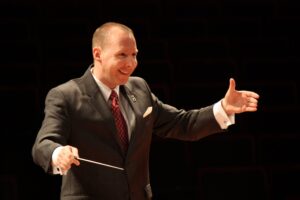
Now in his fifth season with the Sacramento Symphonic Winds, Music and Artistic Director Dr. Matthew Morse is currently Director of Bands and Associate Professor of Conducting in the School of Music at California State University, Sacramento, where he conducts the Symphonic Wind Ensemble and the Concert Band, oversees the Marching Band, and teaches courses in undergraduate and graduate conducting. He is in demand as a clinician, adjudicator, and guest conductor throughout California and nationwide. Under his direction, the Sacramento State Symphonic Wind Ensemble was selected to perform at the California All-State Music Education Conference in Fresno in February 2019.
Prior to his appointment at Sacramento State, Dr. Morse graduated in May 2017 with a Doctor of Musical Arts degree in Wind Conducting from the University of North Texas, where he was a conducting student of Eugene Migliaro Corporon. He also earned a Master of Arts degree in Instrumental Conducting in 2013 from Indiana University of Pennsylvania, where he was a student of Dr. Jack Stamp, and completed a Bachelor of Arts degree in Music from Thomas Edison State University in Trenton, New Jersey, in 2011.
Concurrent with finishing his undergraduate degree in 2011, Dr. Morse retired as a chief warrant officer four following a 25-year military music career with the United States Army. Early in his career, Dr. Morse served for nearly 12 years as a multi-instrumentalist performing primarily on euphonium and trombone and serving two alternating tours each with the 4th Infantry Division Band at Fort Carson, Colorado, and the United States Army Japan Band, Camp Zama, Japan. In 1997, Dr. Morse was selected to become a warrant officer bandmaster and served as the commander and conductor of the 3rd Infantry Division Band at Fort Stewart, Georgia, the 1st Armored Division Band, then stationed Wiesbaden, Germany, and the 282nd Army Band at Fort Jackson, South Carolina. He deployed as a band commander to combat zones in Bosnia-Herzegovina in 2000 and twice to Iraq during a 15-month period in 2003-04. In 2007, Dr. Morse was selected by competitive audition for his capstone assignment as the associate bandmaster and director of the Jazz Knights of the United States Military Academy Band at West Point, New York, where he shared the stage with numerous name artists and soloists.
Dr. Morse has appeared as a guest conductor with many groups, including the United States Army Field Band, the United States Army Europe Band and Chorus, the West Point Band, and the Air Force Band of the Golden West. He has conducted the California Music Educators Association Capitol Section High School Honor Band as well as the Northern California Band Association All Northern Honor Band and the Northern California Band and Choral Directors Association NorCal High School Honor Band. As an instrumentalist, he has performed on bass trombone in recent years with the North Texas Wind Symphony, the Keystone Wind Ensemble (most recently at the 2025 Texas Bandmasters Association convention in San Antonio, Texas in July 2025), various ensembles at Indiana University of Pennsylvania, and the Pueblo Symphony Orchestra in Pueblo, Colorado, along with various freelance settings, including an orchestra backing Bernadette Peters in 2012 and a big band backing Doc Severinsen in 2014.
Dr. Morse’s military decorations include the Legion of Merit, the Bronze Star Medal, and the Meritorious Service Medal with four oak leaf clusters. Other awards and recognitions include being a finalist for The American Prize in the university conductor category, the John Philip Sousa Foundation’s Colonel George S. Howard Citation of Musical Excellence for Military Concert Bands for his work with the 282nd Army Band in 2007, and the South Suburban Conference (Minneapolis/St. Paul, Minnesota area) Achievement Award in Fine Arts in 2013. Additionally, Dr. Morse received the Thomas Jefferson High School (Bloomington, Minnesota) Fine Arts Hall of Fame award in 2009. Morse also holds a second-degree black belt in Tae Kwon Do through Young Brothers Tae Kwon Do Associates in Pittsburgh, Pennsylvania.
Dr. Morse’s professional affiliations include the College Band Directors’ National Association, National Band Association, National Association for Music Education and the California Music Educators Association, California Band Director’s Association, Northern California Band Association, Phi Mu Alpha Sinfonia Fraternity, and Phi Kappa Phi Honor Society.
 SSW is an all volunteer adult community concert band / wind ensemble based in the greater Sacramento area.